Followers

Tuesday, 29 November 2022

Sally Lightfoot.

 One of the highlights from the trip to Fuerteventura was a very short session photographing one of the Sally Lightfoot crabs that was on the shoreline rocks.

This crab is apparently named after a famous Caribbean dancer as the crab can move with great agility in all directions.

It is also a very beautiful species that was certainly worth spending some moments with. A few of the clients went out on the rocks to photograph the crab and I watched from further back deciding that as I got some photos last year I would hold back. However, a few minutes later I noticed that the crab had moved to a position on a higher rock that I thought would give a wonderful backdrop with the sea behind it so I changed my mind and went out onto the rocks to get some shots. A bit of luck with the timing also meant I got a shot just as a wave was hitting the crab. almost certainly my favourite photo from the trip. I also got a photo of the red male with a female next to the male that I didn't even notice at the time!!


Sally Lightfoot Crab and a wave.


Male and Female Sally Lightfoot Crab.


Saturday, 26 November 2022

Plain Tiger.

 One of the butterfly species on our Fuerteventura trip this year that was found in greater numbers than last year was the Plain Tiger.

It was found in several sites, including the same one as last year and once again we found some of the caterpillars feeding on Apple of Sodom. We also found several female butterflies egg laying on the same plant, and one egg I actually saw being laid.

Nearby a few male Plain Tiger were seen feeding on minerals on the path in an area where a water pipe had been damaged so some water had gathered.

This is a really beautiful species that is closely related to the Monarch, which we also saw in better numbers this year.


Male Plain Tiger feeding on minerals.


Female Plain Tiger looking for eggs laying spots.


Plain Tiger larva feeding on Apple of Sodom.


Plain Tiger egg on the same plant.


Tuesday, 22 November 2022

Fuerteventura Pt.1

 I have recently returned from co-leading a Naturetrek tour to Fuerteventura for the 2nd year running. After the drought of last year, this year was a lot greener as the island has had much more rain in recent weeks. This has probably affected the wildlife seen as some species were much easier whilst several were much harder this year.

I will start with some of the birds seen in the Hotel gardens and surrounding area.

Every day Egyptian Vultures were seen flying over, or sitting on the ground feeding near some goat pens on the nearby hillside. Both the darker juveniles and adults were seen with up to 9 at a time. A single Hoopoe was also seen, but only by myself, although one was seen further afield late in the trip. Spanish Sparrows were also in good numbers around the grounds. A Yellow-browed Warbler was very evident each day as it called often. Barbary Partridge occasionally came into the gardens to feed. Probably the most beautiful bird was a superb Fuerteventura Blue Tit that also called regularly. This bird is so much brighter coloured than our garden Blue Tits back home. Both Collared Doves and Laughing Doves were regular. Missing were the Corn Buntings, presumably with more vegetation in the wider area they were finding food easier away from the grounds.


Juvenile Egyptian Vulture bearing ring number A76.


Yellow-browed Warbler.


Male Spanish Sparrow.


Laughing Dove.


Friday, 11 November 2022

Scarce Bordered Straw.

 With the unprecedented influx of Crimson Speckled I put the moth trap out on all the reasonable nights hoping to catch one in the garden. Unfortunately I was not successful, but I did get a few new moths including notable migrant moths.

Earlier in the year I caught some Bordered Straw, but until now I hadn't had the Scarce Bordered Straw, which despite the name is probably the more numerous of the two species!! However, during this extra effort with the trap I did catch at least 5 of the Scarce Bordered Straw and saw the variation in the species with some being much lighter than others.


Scarce Bordered Straws.

A very nice Vestal was also caught as well as my first ever Gem and Brick. (Who thought up some of these names)!!


Vestal.


Gem.


 Brick.


Sunday, 30 October 2022

Beetles and Bugs.

 I'm always keen to find new creatures to see and photograph.

Beetles make up a huge group and are somewhat neglected by myself, although when one is found that I don't recognise I do try to find out if it could be a species that is perhaps scarce or even rare.

This happened in this past week when I went out to check the moth trap and spotted a strange beetle on the patio windows. I potted it up to investigate it further in the daylight the following day. Once I had photographed it I could get down to trying to work out what it was, but scrolling through several sites on the net with no luck I resorted to sending the photo to Bob Foreman from the Sussex Wildlife Trust, and as it happened he was halfway through writing an email to Graeme Lyons who records and monitors beetles among many other things. Graeme immediately knew that it was an Oedemera femoralis, which is a Nationally scarce species with around 50 Sussex records and not many more than 200 in the whole of the UK.


Oedemera femoralis.

Earlier in the year, May 26th to be exact, I came across the Drilus flavescens a very strange beetle that enjoys snails for dinner. This species seems to have become more numerous in recent years. The first one that I saw was actually in the garden of my childhood home when the neighbour spotted it in his garden and caught it to show me when I was visiting Mum several years ago. Since then I have found a few including more in the garden in Lewes.

This one photographed in May was on my patch at the back of Seaford.


Drilus flavescens.

In the past few weeks I have seen 3 Western Conifer Seed Bug. This is actually a member of the Squashbug family, rather than being a beetle. Native to the USA it made it to Europe in 1999 and then migrated from Europe to Britain around 2008. A very attractive bug that is found in the Autumn and is gradually increasing in number. I think the first one I saw was in 2018 when I saw two at home and one in Eastbourne. A very attractive insect, if you like those kind of things, like I do!!


Western Conifer Seed Bug.


Thursday, 27 October 2022

Crimson Speckled.

 Back in 2011, October 4th to be exact, I stumbled across a moth that I hadn't seen before. Unfortunately, I didn't realise the significance of the find until later or I would have taken many more photos of it.

The moth in question was the spectacular looking Crimson Speckled.


The 2011 Crimson Speckled.


Ever since then I have wanted to see another of these beauties. Every time I walk past the spot where I found the moth I remember that day and hope for another sighting.

Well, this year due to weather patterns and a healthy population on the continent there seems to be a massive influx of them. Bearing in mind that this moth had its best year in 2011 since Victorian times according to Colin Pratt, the Sussex Moth Recorder, and during 2011 only 5 of these moths were found in Sussex that year, there have probably been double that number already this year.

On Saturday night a good friend actually caught 2 of these beauties in his moth trap, and my chance of seeing Crimson Speckled again came to fruition. Needless to say, I have put my moth trap out a bit more this week as well as walking in areas where I hope to find one but so far no luck on that front.


Crimson Speckled.

One of the two 2022 specimens I was invited to see.


Thursday, 20 October 2022

Octopus's Garden.

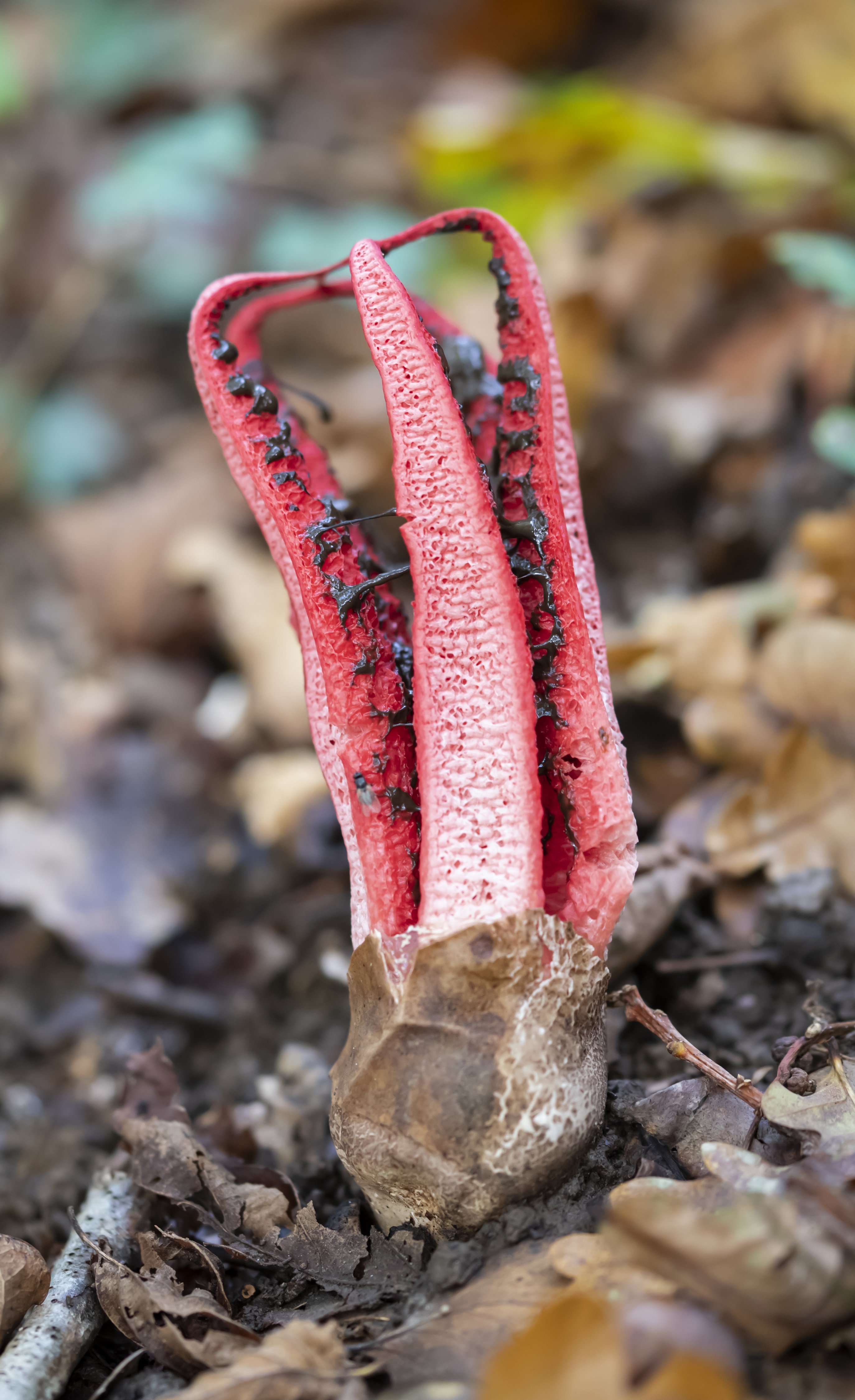
 With Autumn now giving us that beautiful colour show which we enjoy each year it's time to go out looking for some great fungi, and there are few that are as intriguing as the Octopus Stinkhorn. 

Also known as the Devil's Fingers, this species was first seen in the UK around 1914 and originated from New Zealand or Australia although it is also found in South Africa. 

It is still quite a scarce fungi in the UK and is found in a small number of sites with some being in Sussex. The first one I saw this year was just over 2 weeks ago when around 7 were seen with this one being the best example.


Octopus Stinkhorn (Clathrus archeri).


Another visit to the site this week produced many more and in different stages. The first sign is the 'egg stage' which is easy to miss and can be easily trodden on. The main reason that sites for this species is kept pretty quiet and secret!!

The egg stage then starts to open as the tentacles start to push out but just before that happens the colour of the tentacles can be seen through the top of the egg.


Three different Octopus Stinkhorn stages.

Eventually the tentacles come right out of the shell and after a while separate and spread out. These are often eaten by slugs very quickly, but they also smell putrid enough to encourage many flies to feed on them.


Octopus Stinkhorn being enjoyed by 3 flies.

In all there were about 30 of these incredible fungi in the area. Not quite what Ringo Starr was thinking about when he wrote Octopus's Garden, his song that appeared on the Abbey Road album by The Beatles!!

Also in the area were a small number of Dog Stinkhorn. Another strange and fascinating fungi.


Dog Stinkhorn (Mutinus caninus).

At another nearby site more autumnal delights were seen with several Fly Agaric and Grey Spotted Amanita.


Grey Spotted Amanita (Amanita excelsa).