Followers

Monday, 4 May 2020

Caught In The Rain.

With the weather being quite dull yesterday I risked a walk from home hoping that most people would not be on the Downs.

As it happened I hardly saw anyone which was good. My aim was to hopefully find some roosting Dingy Skippers on a bank around 2 miles from home.

The nearer I got to the site the duller it became and then, just as I arrived a steady drizzle started. I was still hoping though to at least find some roosting butterflies, maybe my first Small Copper or Brown Argus of the year as well as those intended Dingy Skippers.

The first insect of interest came in the form of a splendid male Common Heath moth that was so surprised to see a stupid homo sapien out in the rain that it actually sat up in the grass giving a rare opportunity for a photo. Despite the light by now being absolutely dreadful the photo was actually not bad!!


Male Common Heath.

I then found the first of 2 Dingy Skippers at roost. This species generally roost on old seed-heads and then wrap their wings around the seed-head where their camouflage makes them quite hard for a predator to see them. Of course, when it rains the butterfly gets wet, just like the bloke that is taking their photo. I was quite lucky that in the background there was a good clump of Horseshoe Vetch that gave the photo a bit of colour in the dreadful conditions. Meanwhile the butterfly was covered in water droplets.


Roosting Dingy Skipper.

A little further up the hill I came across the 2nd Dingy Skipper. This one was getting even wetter than the first one on its chosen seed-head. The backdrop for this one was the opposite side of the valley which being lighter showed the droplets up even more. There was presumably a droplet on the eye which gives the impression that its eye was very large.


Roosting Dingy Skipper.

By this time I was soaked through, a bit similar to the Skippers, and I was glad that the camera is meant to be waterproof. 
I then saw a larval web with lots of tiny caterpillars in it. As this is the main area where I found a colony of the Small Eggar 5 years ago, a very rare moth in Sussex, I was hopeful that I had come across some more. On closer inspection, that meant getting even wetter, it was clear that these were the Small Eggar, and another web nearby was even better news. 


Small Eggar larval web. (the larvae hiding from the rain under the web).


Small Eggar larvae photographed from underneath.

In the end a very successful afternoon in weather that really warranted staying at home and listening to Pink Floyd!!

A couple of other photos from the past few days included my first Common Blue of the year, late in the day on May 1st.


Male Common Blue.

Also a female Holly Blue from the garden.
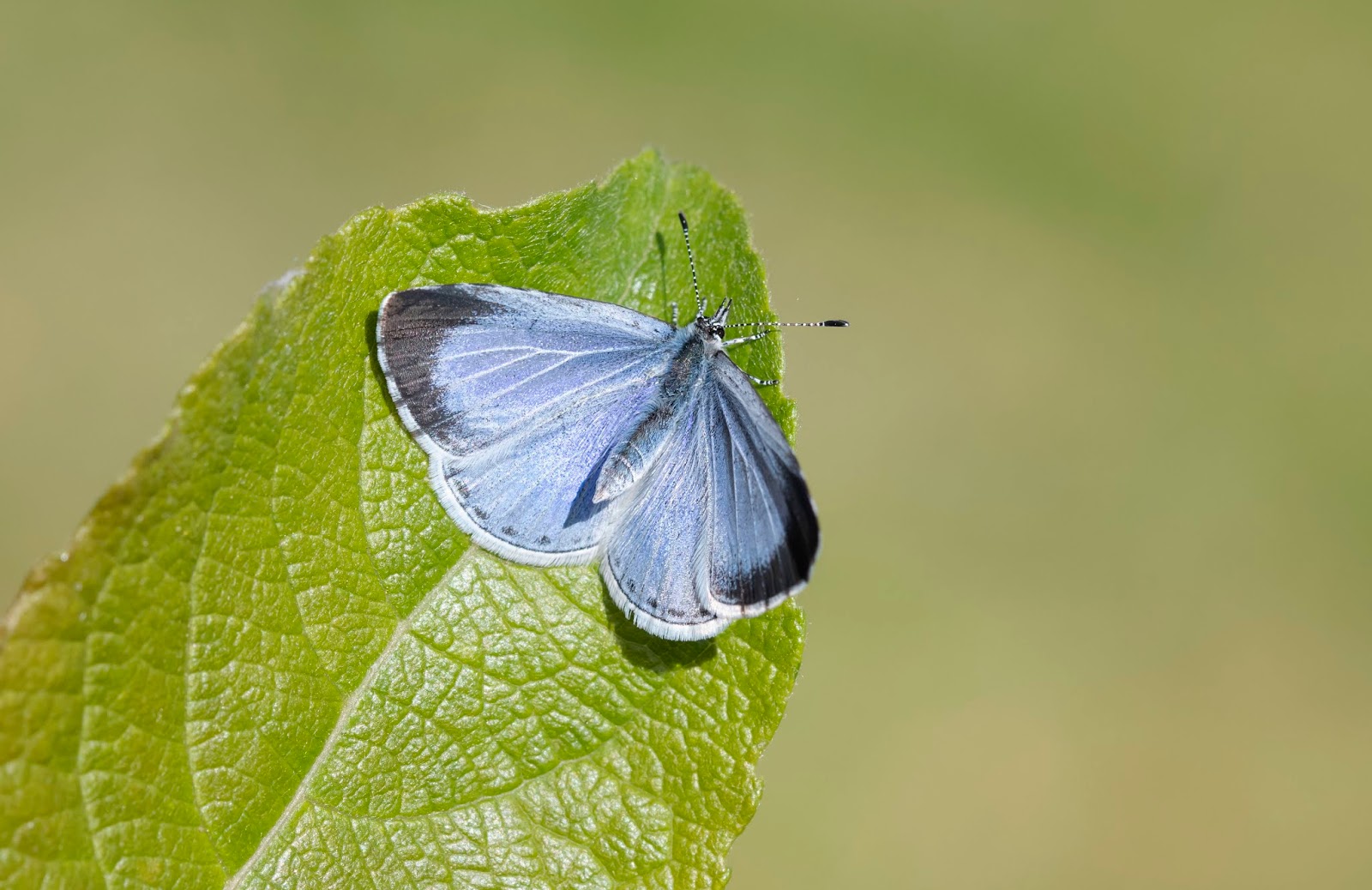


Female Holly Blue in the garden.


Wednesday, 29 April 2020

More Grizzly Tales.

With Monday looking to be the last decent day for a while I once again had an early morning walk up to my local patch.

I was a little later leaving home at 6.30am in bright sunshine, however, it was soon apparent that the area I was heading was in thick fog and that probably saved the morning as it was too cold in the fog for any butterflies to fly. As once again I was hoping to find them at roost and then photograph them as they woke up.

On the way I did have a good view of one of the regular Roe Deer with a Fox in the same location.

Once on the patch I quickly found a roosting Grizzled Skipper, but this one was quite worn. I then quickly found 2 more, the first of which had just started to open its wings. The other one though was in a really good position on the end of a young bit of Hawthorn and after a short wait it started to open and give me some fabulous opportunities. 


Female Grizzled Skipper.

I also came across a beautiful Pyrausta nigrata, one of the regular micro moths but one that rarely sits still for a photo.


Pyrausta nigrata on Salad Burnet.

I also saw 3 of the really tiny Elachista subocellea. This is a much rarer micro moth and was until I found this colony a few years ago, only known from one hillside in Sussex. Since then a few more colonies have been discovered locally including another by myself around 3 miles away.


Elachista subocellea.

I then walked a little further where James was also out looking for butterflies. In that area we found 2 more Grizzled Skipper roosting, as it was still shaded here, a Dingy Skipper and some Green Hairstreaks. He had also spotted a Small Copper before I arrived, but we couldn't relocate that one.


Roosting Grizzled Skipper. 


Green Hairstreak.

Some really good views of Blackcap and Yellowhammer were also worthwhile, although with only the macro lens these were only seen.


Friday, 24 April 2020

The Waiting Game.

Another stunning early morning once again saw me walking up to the patch at 6am hoping again to find some Grizzled Skippers.

Only one was found at roost as it happens, but as it was roosting on the end of a small bit of Hawthorn I waited, and waited more for the butterfly to open up once the sun was strong enough to warm him up.

I probably waited by the butterfly for around an hour before the moment he started to open, and then many minutes more before he fully opened.

The position he was in was really good as the background had a hint of the colour of Ground Ivy that helped improve the image further.

After many years of being slightly disappointed with my Grizzled Skipper shots, with these photos I feel I have at last got some that I am pleased with.


Grizzled Skipper in the early morning sunshine. (7.45am).


Just about to fly.


Grizzled Skipper on Salad Burnet.


Following this bit of success I then came across 3 Green Hairstreak in an area that I don't often see them in, then moving on to my normal Green Hairstreak site several more were spotted.


Green Hairstreak.

I also checked out the Lackey Moth larval web and saw most of the larvae out of the web and sunning themselves on the bush.


A stream of Lackey Moth larvae.

Two days further on and I had a mid morning walk in the Green Hairstreak area where around 7 were seen.  Strangely, the only one that posed well was the same butterfly again and one other worn individual.


Green Hairstreak.

I also saw my first Dingy Skipper of the year today and several Hairy Dragonflies.


Tuesday, 21 April 2020

Nightingale in Grizzly Country.

Despite the continuing windy conditions yesterday I decided to attempt another early morning stroll up onto the patch hoping to see my first Grizzled Skippers of the year.

Not long after starting my hunt for roosting Skippers I heard the unmistakable sound of a Nightingale in the scrub nearby, a beautiful sound and one I wasn't expecting to hear this year as it seems unlikely I will be able to visit the woodlands where I normally hear them.

I then spotted 2 Grizzled Skipper asleep just before the sun reached them, very soon the female started to open her wings to warm up for the day.


Female Grizzled Skipper.

She then started to nectar on the Ground Ivy before flying off.


Grizzled Skipper on Ground Ivy.

Meanwhile the Nightingale was still calling in the scrub and with it being so close I tried to record it on my phone.  At present I don't seem to be able to make the download work so bear with me as I put my technical team onto it (Matt)!!
Now working thanks to Matt.


Nightingale singing. Turn the sound up!!

With it remaining breezy I wasn't expecting to see much more, but a stunning view of a hunting Stoat and finding a web of Lackey Moth larvae was rewarding.


Lackey Larvae in larval web.

A very fresh female Wall Brown  also showed briefly.


Female Wall Brown.

In one sheltered spot my first Green Hairstreak of the year also showed briefly and on the return walk home a very nice female Speckled Wood showed well.


Female Speckled Wood.


These early morning sessions have been quite rewarding and I have attached a couple of other shots from the past few days including a landscape taken last week with the sun starting to rise. An unusual shot for me to take.


Green-veined Whites on Cowslip.


A Misty View.


Thursday, 16 April 2020

Beating The Crowds.

With the current restrictions in place I have only managed to get out for my permitted walk a few times, and with having to be extremely careful I am trying to get out before all the dog walkers, which basically means before the sunrise.

Fortunately, my usual patch is just about in range by walking from home and I have a little time to search out the best haunts that I have learnt over the years.

Unfortunately, with the never ending Easterly winds that blow straight onto the site most of the insects are appearing later this year and I still haven't seen any Grizzled Skippers or Green Hairstreaks, but they are due any day.

Over the weekend the light had started to improve when I found a pair of very fresh Green-veined Whites at roost and I managed several shots of these including the 2 below.

Today I found my first Wall Brown of the year. By the way it was behaving I think it had emerged today, and it was in excellent condition and only flying very short distances.

Other highlights during these early walks have been, apart from the Large Tortoiseshell in an earlier blog,  2 Brown Hares, many Whitethroat, Humming-bird Hawk-moth, Cinnabar Moth and an immaculate male Wheatear.


Green-veined White on Hawthorn.


Male Wall Brown.


I have only moth trapped twice so far but I have managed to get a couple of firsts. The Nationally rare Barred Tooth-striped and a Streamer. The Barred Tooth-striped does have one of its known strongholds nearby so this perhaps shouldn't be too much of a surprise.


Barred Tooth-striped. 


Streamer.


Sunday, 12 April 2020

Transformation.

2 years ago I was approached by Pete Eeles, who was in the process of writing his superb book 'Life Cycles of British and Irish Butterflies' as he wondered if I had a photo of a Wall Brown larva in the pre-pupation state.

At this point in time I had only seen this once before and that particular larva was in the process of being eaten by Ants.

I thought the only way I could get the shot Pete was after would be to bring a larva home and try to rear it through, not something I am that keen to do as I prefer to get my shots in the wild.

As it happened it did give me the opportunity to find out several things concerning timings etc. of this early part of the life cycle, and eventually after watching it daily the larva got into the position that Pete and I were after.

Strangely, the following day I actually found 2 more pre-pupation larvae on my usual patch which was much more exciting, although one of these was eaten by Ants the very next day.

The most surprising thing was that the pre-pupation stage went on for 5 days, this is the stage when the larva is at its most vulnerable as the skin is still soft and the larva is not able to escape any of the predation species.

Fortunately, by rearing the one at home it did take away several of the hazards and after completing the pupation stage the butterfly, a female, emerged 29 days later.

This year I decided to have another go to see if all the patterns were the same. This time the pre-pupating stage took 4 days, and on the 4th day I checked the larva in the morning and it was still as it was, but in the afternoon I spotted that something had changed. I quickly got the camera and then for the next 18 minutes watched and photographed as the larva struggles to get out of its old skin and turn into a pupa. It all happened so quickly, and even though I had missed the start of the transformation, the head case had already come off along with a good part of the skin, it was fascinating to watch and it was probably the most the larva had moved in its entire life. Any Spider that saw it could have easily taken and eaten it.

I would have liked to have had a movie sequence as it was surprising how much the larva wriggled, but as I was hand holding the camera it wasn't really feasible.


Wall Brown pre-pupating larva. 3/4/2020.


In the process of pupating. (note the head casing and old skin).
7/4/2020.


Swinging around trying to lose the old skin and head casing.


Nearly complete and taking shape.


After 18 minutes of watching and the pupa shape is just about complete.


30 minutes later the old skin and head case has fallen away.


The Pupa as it is today, 12/4/2020.

It wasn't until I was processing this shot that I spotted the small Spider just below the Pupa. I quickly had a look in case the Spider was having a very big meal. I couldn't see the Spider on checking and it looked as though the pupa was still okay.

I now hope that the pupa makes it through to becoming a butterfly. This is such a perilous time for the insect and so many do not make it through due to predation or the weather.


Wednesday, 8 April 2020

A different View.

With the Emperor Moth season gaining pace I wanted to try and get a decent shot of the under-side of a male, while they are still fresh.

This spectacular moth is more common than most people realise, but to see one is always a special moment and to get a specific type of photo of them can never be guaranteed, but I was still quite hopeful, and after getting the photo, very pleased.

This angle really shows the spectacular feathered antennae which the male moth uses to find the female. It is thought the male can pick up the female pheromones from around a mile away with these antennae.


Male Emperor Moth.