Followers

Saturday, 20 April 2019

The Green Greenie.

I owe a couple of favours to my good friend Paul, so it was a relief to pay back a little bit to him this week. He wanted to join me on a Green Hairstreak hunt as it has been a few years since he managed a decent shot of one, so yesterday, in great conditions we ventured onto the Downs with the sole purpose of finding a pristine individual that would also perform well for us.

In all we saw at least 6 individuals, although many of my usual bushes were still not occupied, so hopefully there are many more to come. Eventually Paul spotted one that was on ground level, all the others to that point had been sticking to the tops of the bush-line.

For the next 20-30 minutes this one performed for us, although I was a little disappointed with most of my results considering how well it did sit for us, albeit at times at angles that were difficult to get to.

I also managed a few shots on the previous day including a very smart punctata form, where the white streak goes through both the fore and hind-wings.


Nectaring on the blossom.


A punctata form.


Another punctata form from the day before.

In one of the dew ponds several Newts were showing, along with many tadpoles. 


Newt just below the surface of the water. 


Thursday, 18 April 2019

Warmth at last.

With warm and calmer weather at last the day started off with opening the moth trap, as it was the first warm night after many very cold nights I shouldn't have expected much and it shouldn't have been a surprise to only get 5 macro moths. However, when I put the trap out the night before I was hoping to find a Mullein Moth the following day and that is exactly what happened. This is only my 2nd Mullein and the first for 5 years.


Mullein Moth.

The only other notable moth was my 2nd Brindled Beauty.


Brindled Beauty.

I then went for a stroll around the patch where the first butterfly seen was an early Small Heath shortly followed by a Dingy Skipper.


Probably the first Sussex Small Heath of 2019.


Dingy Skipper.

A search for Grizzled Skipper was unsuccessful but whilst looking for these I spotted a female Emperor Moth. This is only the 3rd female I have found in the field, and of those only one was in pristine condition. This one unfortunately wasn't, but it is always a special moth regardless to find. Hopefully she has laid many eggs in the vicinity for future generations.


Female Emperor Moth.

Only a single Green Hairstreak was seen and this one unfortunately stayed high in the bushes. Another new species for the year was a Holly Blue that flew along the bush line.
The session finished off with a quick look for Marbled White larva. One was found almost immediately and as occasionally happens this one sensed my presence and went into its defence position, trying to look large. Not easy when you are only just over 1 cm long!!


Marbled White larva.

There were also several Pyrausta ostrinalis micro moths flying, and for once I found one that was extremely fresh, showing off the superb colours on this tiny gem.


Pyrausta ostrinalis.

Finally a wonderful Toad put in an appearance to finish the day off in style.


Common Toad.

The only slight disappointment was the lack of Wall Brown. I was hoping to see at least one of these, but I'm sure they will be flying extremely soon!!


Monday, 15 April 2019

Chiffchaff.

There are certain sounds and sights that for the naturalist are a sure sign that Spring is here. Orange-tip butterflies are my favourite Spring sight, but for the sound it has to be the call of the Chiffchaff.

It has been a few weeks now since I heard my first Chiffchaff calling this year, but now the sound of them are everywhere.

Today I went for yet another walk over the local South Downs hoping to see a build up of Grizzled Skipper and Green Hairstreak, but once again the cold wind kept all but a few butterflies in hiding. Just a few Brimstone, Peacock and Comma were seen, although I did see my first Large Red Damselfly of the year.

All along the valley I was listening to the Chiffchaff call and at the point where I planned to turn around to head for home I came across a particularly showy individual. It was a good excuse to try the new camera with the small 300mm lens. I have to admit I was mightily impressed with this combination, even with a converter fitted. It wasn't quite good enough to read the details on the leg ring that the bird was wearing though!!


Chiffchaff


A distant Oil Seed Rape field adds colour.


Chiffchaff  calling on Blackthorn.


Chiffchaff showing off the ring.


Friday, 12 April 2019

Assorted Delights.

With the season continuing apace despite the very cold wind there have been a few highlights this week.

On Wednesday a walk with Nigel produced our first Swallows and House Martins with a pair of each flying together. A great view too of a stunning Stoat that unfortunately saw us before it was in camera range. Several Orange-tips seen along the way as well as Peacock, Red Admiral, Comma, Brimstone and Speckled Wood. A Chiffchaff also allowed a close approach.


Chiffchaff.


Wood Anemone.

It was back on local turf the following day when I was lucky to find a single Grizzled Skipper and Green Hairstreak. Good to get these favourites ticked off for the year, but hopefully some much better photos of each to come. A stunning male Common Redstart was also seen along the valley.


Grizzled Skipper.


Green Hairstreak on Gorse.

Another stroll today to see how the local Early Spider Orchids were coming along was a little disappointing with only 4 spikes found in a short hunt. 2 of them had a single flower on them. 4 more Swallows seen and a pair of Yellowhammer.


Early Spider Orchid.


Female Yellowhammer.


Herb Robert.


Tuesday, 9 April 2019

Bombylius major.

In cool conditions yesterday I was strolling along a track on the local downland when I spotted a Dark-edged Bee-fly that looked asleep on some foliage. I carefully crept closer and prepared to take the photo when it suddenly took flight.

This was a bit of a shame as I don't often see these handsome insects resting off the ground and this would have been I'm sure my best image of one of these to date.

About 40 minutes later I was walking back the same way when I spotted another Bee-fly resting on a Hawthorn sapling. I was even more careful this time taking a few shots with the longer lens before getting in close with the macro. This one was so fresh I think it had recently emerged and was drying off on the sapling before its maiden flight. It was wonderful to be able to get some detailed shots that really showed off its intricate wings.


Dark-edged Bee-fly (Bombylius major).


I then took my good friend Paul out looking for Orange-tips. There we met up with James who had just been photographing some Orange-tips at roost on some Cuckoo-flower. Unfortunately for us the weather had warmed up just before we got there and the butterflies had taken flight. However, a couple of brief opportunities when the butterflies settled allowed a couple of shots.


Male Orange-tip.


Male Orange-tip on Lichen.

Several Comma were also performing well in the area. I also saw my first Green-veined White of the year bringing my 2019 species list up to 10. Probably 20% of my British species sightings now seen which is a little depressing in a way!!


Comma on Blackthorn.

The day before I had come across several of the quite rare micro moths Pyrausta ostrinalis that are regular on my local patch. This is a very early record for this moth according to the Sussex moth recorder.


Pyrausta ostrinalis.


Sunday, 7 April 2019

Marbled White larvae.

With some unexpected sunshine this morning, albeit short lived and still an irritating breeze, I headed up to the patch in the off chance of seeing my first Wall Brown of the year. It was a bit of a long shot, but then I had a phone call from Pete who told me that he had found one at Castle Hill in Newhaven, whilst he was doing a transect with Dave Harris. This is the first time for many years that my local site or Mill Hill hasn't had the first Wall Brown of the year in Sussex.

Anyway, I decided to look even harder, but alas I couldn't find any. Only a Small Tortoiseshell was seen on a disappointing butterfly day. Several micro moths were seen though including my first Pyrausta ostrinalis of the year.

While I was looking for Wall Brown pupa I did find 2 Marbled White larvae. My 2nd and 3rd of the year. These were both tiny at around 1 cm long.


Marbled White larva.


Marbled White larva.

A couple of days ago I came across a Dotted Bee-fly resting along the valley. This is the rarer of the 2 Bee-fly that are found on the patch.  The Dark-edged Bee-fly is found all over the area but the Dotted is generally only in a couple of areas there.


Dotted Bee-fly.


Wednesday, 3 April 2019

The Mating Game.

I have recently updated some of my camera gear which gave me a few problems as I was unable to process some of the photos. However, normal service has returned so I can now share some of the recent additions.

On a walk along a local path I saw 2 Brimstone tumbling together in the far distance, but instead of a brief tumble which Brimstone often do these 2 stayed together. Looking through the binoculars, as they were around 200 metres ahead of me I could see that there was a male and female so I started to walk much quicker. I was still some distance away when they went into the undergrowth and didn't come back out again. It was then trying to work out exactly where they dropped and a concentrated search. I just could not find them and after several minutes I was about to give up when I spotted them hiding under a Bramble leaf. I then had to climb over a barbed wire fence with the camera and try to get some photos. Of course, the background was far from ideal, but I was generally pleased with getting a photo as I can't even remember seeing Brimstone mating before.


Mating Brimstone hiding under a Bramble leaf.


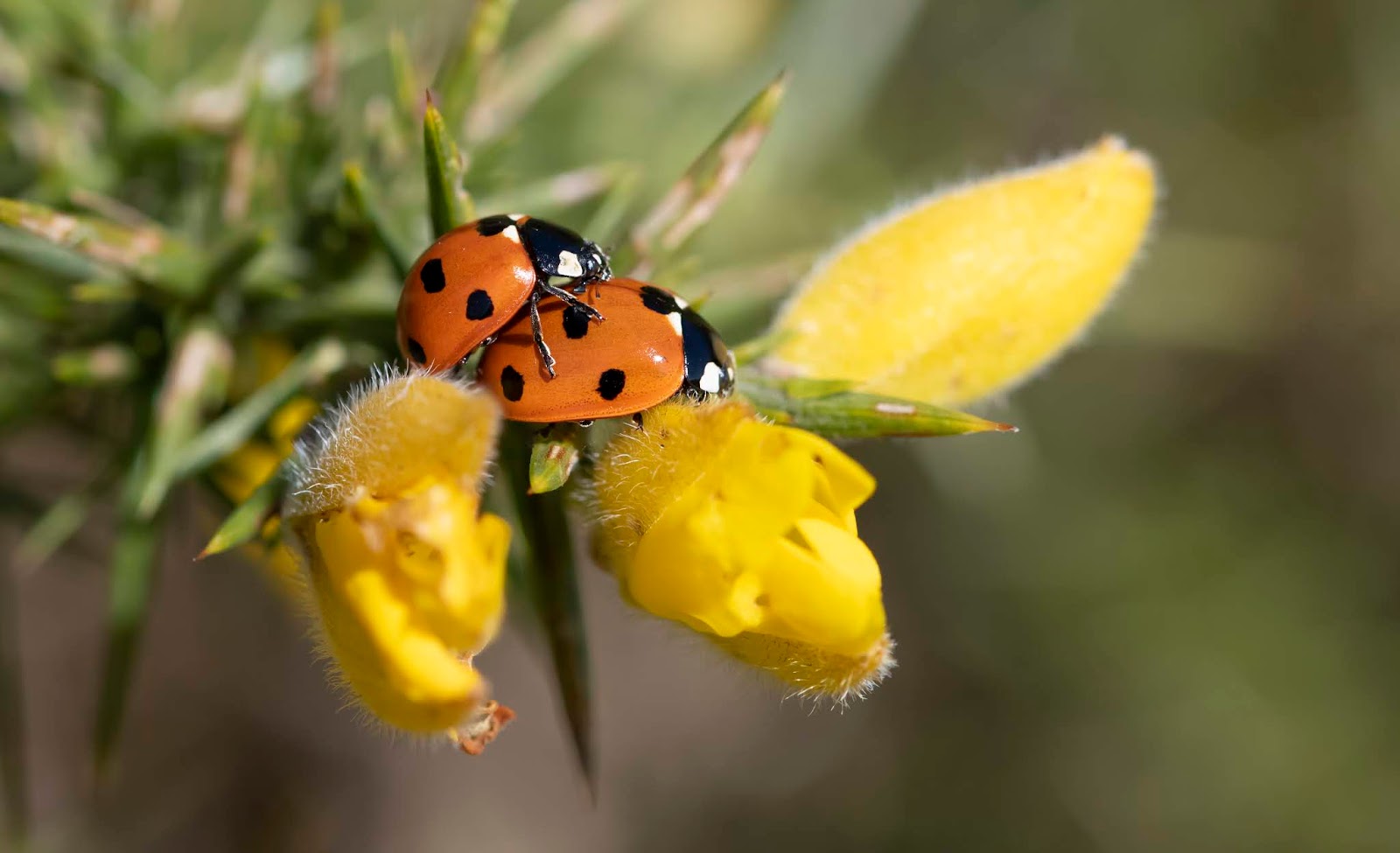
7 Spot Ladybirds mating on Gorse.

The following day I was invited to join David and Malcolm who were going to Rye Harbour where a Black-necked Grebe in near full breeding plumage was showing quite well. 
With the bird not coming quite close enough and the sun always being slightly in the wrong position I was once again quite pleased with how the camera performed and gives me hope for the Summer.


Black-necked Grebe.


Little Grebe also showing well.