Followers

Sunday, 31 March 2019

Emperor.

With cooler conditions today and a breeze blowing it was never going to be such a good day for butterflies today. I decided to go and check out the Wall Brown larva that I had found a couple of days ago to see how it was faring and if it was now looking more like how a Wall Brown larva was meant to look.
It quickly became apparent why the larva was looking different as it had started to turn into a pupa, being attached to a grass stem. I very carefully photographed it in situ and made sure it was well covered up as I left it. I then cleared some of the cut scrub that was still around after my Winter clearing some distance away.


Wall Brown larva changing into a pupa.

At this time of year the Emperor Moths have started flying and I was lucky to come across one to photograph as well as seeing a couple more on the wing. This is one of the most spectacular of Britain's macro moths and is always a delight to see.


Male Emperor Moth.

Heading back to the car I quickly checked the Wall Brown larva/pupa and was met with the dreadful sight of a Wolf Spider eating the unfortunate pupa. It appears that it had started the final transformation of wriggling out of its larval skin and the Spider had seen the movement and attacked it. Such a shame after all the effort of growing to the stage of pupation to be killed before it could become a butterfly. I have now seen 3 in this stage over the past few years that have been eaten, although the other 2 were attacked by Ants.

Saturday, 30 March 2019

Butterflies Spring out.

With the fabulous warm weather over the past few days the species of butterflies flying has literally taken off.

With my first Orange-tip yesterday and lots of Small White too it was not a surprise to find 2 Speckled Wood along a local woodland path. One of them even had the decency to pose in a pretty good position for me. They were around 50 metres apart along the path, but on the return one had moved along the path into the other ones territory and a long battle commenced.

On another stroll today another 4 Speckled Wood were seen, including one that had a good part of a wing missing. Not good for the butterfly so early in its adult life.


Male Speckled Wood.


Thursday, 28 March 2019

Pine Beauty.

With a calmer and milder night I put the trap out again last night. A larger number of moths this morning although there were not any rarities. However, it was nice to get my first Pine Beauty of the year, and only my 2nd ever. A few Early Grey were also in and around the trap.


Pine Beauty.


Early Grey.


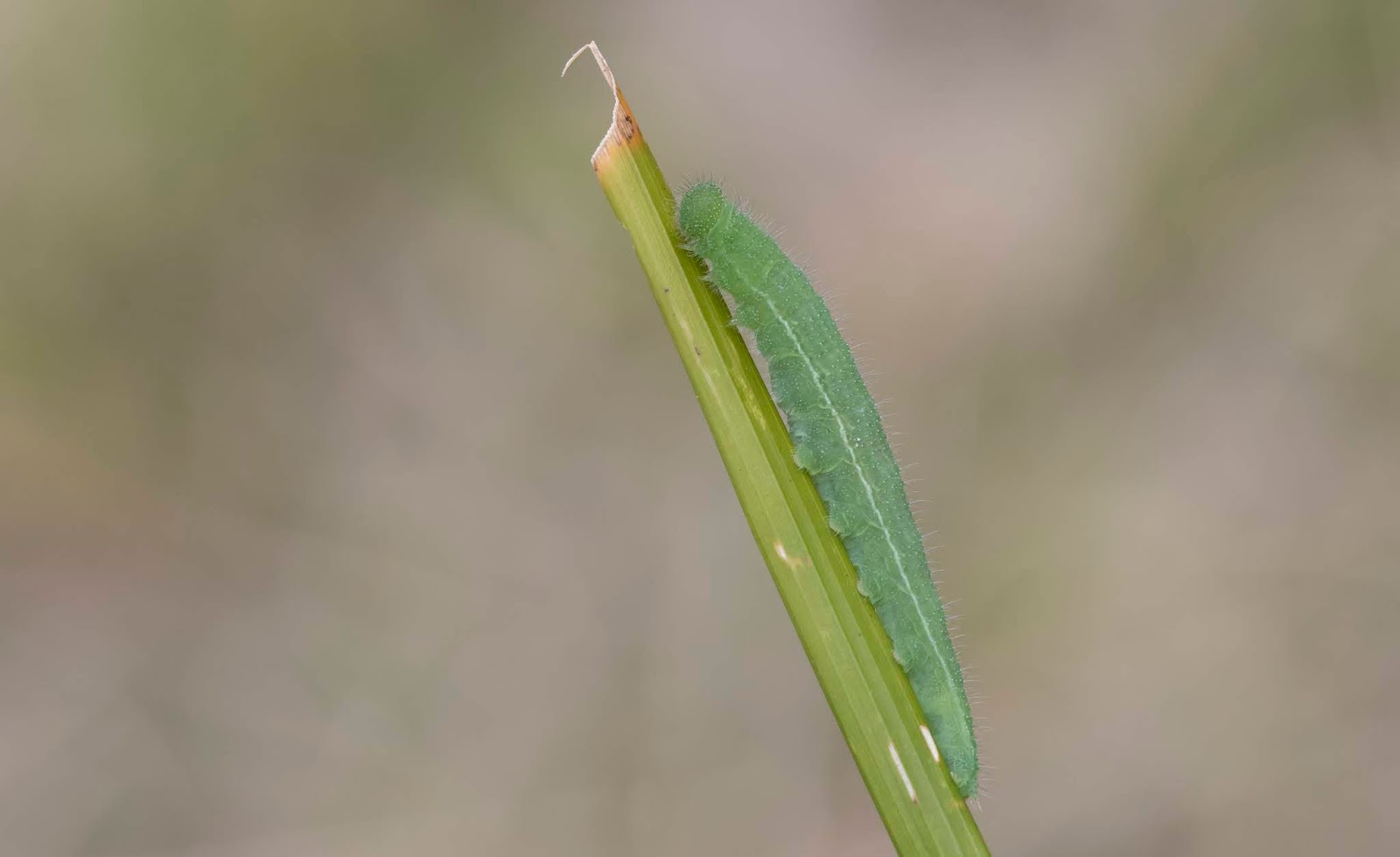
A stroll around the local patch searching for Wall Brown larva was a little poor with most of the larva now going missing as they approach fully grown. This normally happens around now so it looks as though my highest count of the year at 18 will not be beaten. This is well down from the 40 in a single visit last year. 2 new larva that I hadn't seen before were found however including one that lacked the white line along the side and was also a brighter green. It didn't look quite right for a Wall Brown, but it is not right either for the other 2 possibilities either, so I guess it had just moulted.


Wall Brown larva.


Probable Wall Brown larva freshly moulted.

On the moth front I had my first Common Heath and Pyrausta despicata of the year and numbers of the tiny micro moth Ancylis comptana have grown over the past few days. This moth is just 5mm long and very hard to follow when they fly. A bit of time was spent hoping to improve my poor shots of this moth from years gone by.


Ancylis comptana.


Thursday, 21 March 2019

A Couple of Beauties.

With the weather a little more settled at long last on Tuesday evening, following storms with very high winds and lots of rain, it was a chance to put the moth trap out for the 2nd time this year.

The following morning a catch of moths that just made it into double figures with a few very common moths. However, it was good to get my first ever Brindled Beauty, as well as another Oak Beauty and a Twin-spotted Quaker that made it all worthwhile.


Oak Beauty.


Male Brindled Beauty.


Twin-spotted Quaker.


Tuesday, 12 March 2019

Crossbill Bath-time.

During the Winter I have had several sessions with Crossbill. A bird I have seen on numerous occasions over the years but have never managed to photograph successfully.

My earlier attempts this year were in Kent, but the last couple of efforts were closer to home in Sussex. It was also an opportunity at last to use my portable hide. This really came into its own with being able to be close to the birds without disturbing them in any way, and being able to observe them bathing and drinking from just a few metres away.

As ever at this time of year the weather didn't play ball all the time and there were several times when clouds built up much earlier than predicted, however, several observations were in full sunshine.

On the first attempt a pair arrived at the drinking pool early on and the female was quite content to walk into the pool to bathe. The male however always had foliage in front of him as he drank.


Female Crossbill poolside.


Female Crossbill starting to bathe.


Splashing around.

A while later, after the clouds had built up another visit from the pair produced a few more shots including the male drinking, albeit with a little foliage in front of him.


Male Crossbill drinking.


Female Crossbill just before dropping to the poolside.


Female drinking.

The following attempt was very quiet and it was looking as though the birds may have moved on, when out of the blue a flock of 20-30 birds landed in the surrounding trees. It was then a further wait for the birds to slowly drop down to bathe and drink. It was also very noisy with birds calling all around. A few birds went to the pool giving a short opportunity for some photos before all the birds flew away.


Male Crossbill.


Male Crossbill drinking.


Female Crossbill bathing.


Female drinking.

A much quieter day, despite the one flock arriving in the several hours spent brought my Crossbill attempts to an end for this Winter/Spring. The thought is now that most of the birds will have paired up so there will only be very infrequent visits now to the many pools.


Thursday, 7 March 2019

Oak Beauties.

A few years ago, after purchasing an MV mothtrap, my first moth was an Oak Beauty. I joked at the time that the moth had cost me around £350. Of course it wasn't long before many more moths had been caught, so the cost of each moth reduced dramatically!!

However, I hadn't caught another Oak Beauty until last week, when I put the trap out for the first time this year. The following morning there was an Oak Beauty on the fence by the trap, and a darker individual inside the trap. A March Moth was the only other moth caught.

Despite the Oak Beauty being a very well patterned moth it is extremely well camouflaged when sitting on the bark of a tree.


The two Oak Beauties caught.


The darker Oak Beauty.


A more normal Oak Beauty.


March Moth.


Thursday, 28 February 2019

Dorset Delights.

For a few weeks I have so nearly been tempted to head down to Weymouth as the 2 RSPB reserves there have had a couple of rare birds over-wintering there and both have been showing extremely well. 

It was after seeing the blog post and photos from a birding friend of mine and Matt's from Oxfordshire, Ewan Urquhart of the excellent blog that I follow, Black Audi Birding, that David and I decided we had to take the plunge as Ewan had also come across a Penduline Tit as well as the Ring-billed Duck and the Lesser Yellowlegs. The Penduline would actually be a brand new bird for me.

David arrived promptly and we left my place before 5am to make sure we missed the worst of the traffic, and after a drive of 2hrs 40 minutes we arrived at our first destination of Radipole Lake. 
It was at this destination that Ewan had also found some Bearded Tits performing well, so we followed the general direction that Ewan had mentioned and low and behold we found a pair of Bearded Tits in next to no time. They appeared to be happy feeding on the Reedmace rather than the usual reeds we normally see them on. It wasn't easy getting clean shots of the birds with all the other reeds swaying about in the gentle breeze, but we both got a few pleasing shots.


Male Bearded Tit on Reedmace.


Female Bearded Tit feeding on Reedmace.


Seeds going everywhere.


A classic pose of a male Bearded Tit.


A male Bearded Tit looking very smart.

Following our success with these little beauties it was off to find the Ring-necked Duck, a duck that would normally be in America. As it turned out it was easy to find as another birder caught our attention from the other side of the water, so it was just a short walk once we had got back to the car-park to stroll down the other side of the water.
To start with the bird had gone into hiding, but after 5 minutes the bird re-appeared and was quite content as it swam up and down the channel. Much easier to photograph than the bird at Dungeness last Winter!!


Male Ring-necked Duck.


Subtle colours in the head plumage.


Common Pochard were also in attendance.

It was still the morning when we eventually left Radipole for Lodmoor, which is just a 10 minute drive away.

Bad news as soon as we arrived here as the Lesser Yellowlegs had vanished after being seen earlier in the day, and the Penduline had not appeared at all today despite several people looking for it over several hours.

A very smart male Ruff was on show though, and this was a bird that the Lesser Yellowlegs often seems to feed with, but not today!!


Male Ruff feeding.

Several Teal were also showing well.


Male Teal.

After quite some time, and still no positive news on the Penduline Tit I suggested to David that perhaps we should head over to the area that the Penduline had been seen in before today, just for something to do. By now we were both beginning to wilt, but with nothing to lose we walked to the opposite side of the reserve. The path that runs in a straight line at this point was empty apart from a group of 3 people a few hundred metres ahead that were looking through binoculars, and appeared to be watching a bird. We quickly sped up and as we arrived at where the birders were they pointed the Penduline out to us. After several hours of searching the bird had appeared just a couple of minutes earlier. I got a quick record shot just as the bird flew. Fortunately, just a few minutes later it re-appeared at the top of a small bush which gave us great views. We then watched it almost continuously for the next 30 minutes.


Male Penduline Tit.

We were now feeling very lucky, so we headed back to the area where we thought the Lesser Yellowlegs was bound to be showing. However, all we found were a few people looking pretty dejected as the bird was still not around. With this very un-seasonal weather it was always likely that the bird would have moved on, although with it being seen earlier in the day we were still hopeful it was around. With the sun starting to get low in the sky I suggested to David that we slowly make tracks back to the car and we started to take down the tripods. It was at this point I saw a different wader in the next pool along. A quick look through the binoculars confirmed it was, at last, the Lesser Yellowlegs. Better still, it was walking towards the pool where we were. With the car-parking ticket running out, and the sun getting lower than we wanted the bird performed extremely well for us and a few other patient birders. Just in the nick of time!! Our 2nd American bird of the day.


Lesser Yellowlegs.


Mission accomplished with all targets hit.

With the return journey taking just a little over 3 hours it had been a very long day, but very rewarding. My thanks to Ewan for inspiring us to try for them.