Followers

Tuesday, 21 May 2024

Double Delights In Kent.

One of my favourite places to visit, is deep in the Kent countryside in May. Although I have Duke of Burgundy nearer in West Sussex, I love seeing them in woodland habitat, and there is always the chance of some interesting and rare moths, deep in the Kent woodlands. In fact, the main target these days on my Kent visits, is the chance of encountering my favourite little micro moth, the Anania funebris, also known as the White-spotted Sable. This moth is now probably extinct in Sussex, with the very last sightings in the county being in 2018, when Mike Mullis and myself both saw singles at a private wood that we survey. 

I love visiting this area of Kent so much that this year I have done it twice. The first visit was with David. It was also my birthday, which was also the first day of me officially being a pensioner!!

The weather was actually perfect, with our arrival being in overcast conditions, but as we got to the area with the Duke of Burgundy, the sun started to show through, which meant the butterflies started to appear. The first of which was a male Duke of Burgundy that I spotted in less than a minute of us arriving on site.


Male Duke of Burgundy.

Moments later David spotted a female that was basking with her wings wide open. We both managed to get several images of her as she fluttered about. It was so lovely getting these opportunities so early in the day.


Female Duke of Burgundy.

As the day was now warming up quickly, the butterflies became more active, so we started to wander about. We did come across several lovely Fly and Lady Orchids.


Fly Orchid.

I also spotted the first Anania funebris. We both followed the tiny moth for a few minutes, and tried to photograph it as it sat briefly several times, although we never really stood a chance. This species is extremely difficult as it mostly hides under leaves and seems to sense any movement, so it is constantly flying off again. It very quickly vanished, and despite searching in the area, we never did see that one again!!

We then headed away from the main site, to another area up the hill. Here David spotted another micro moth that I don't think I've seen before. The Ancylis unculana is rare in Sussex, only found in a few sites in West Sussex, so it was a really nice find. Unlike the Anania funebris, it also just sat there for us to photograph it.


Ancylis unculana.

Not long after this, I spotted another Anania funebris. Once again, the moth gave us the run around. It was in terrific condition, and as it was my main target for the day, I was really keen not to lose this one. Once again it kept hiding under leaves and flying off whenever we got within a few feet of it. It was beginning to look like a lost cause. Just before we gave up though, it sat for a longer time under a leaf, and I very carefully turned the leaf over, expecting it to fly as soon as there was some movement, but amazingly it actually stayed on the leaf. Although I was holding the leaf with one hand, we both managed to get a few shots of this beautiful rare moth.


Anania funebris (White-spotted Sable).

Following this success, we decided to head off to visit a site for the Man Orchids. However, before we left we did enjoy watching more Duke of Burgundy and Green Hairstreak and also admiring the Lady Orchids.


Lady Orchid.

At the downland site for Man Orchids we came across a very fresh Holly Blue. Although these blues are common, I rarely get them in a position to photograph them. As it was now very warm, the butterfly wasn't going to open its wings, but it was still nice to see it close up.


Holly Blue.

The Man Orchids were unfortunately, not fully in flower, so we didn't spend too much time with them. The long drive home though, was made easier knowing we had had an extremely good day!!

I actually enjoyed the trip so much, that I decided to do it all again 9 days later. This time I took Lisa, as she was keen to look for some of the rare orchids that are found in Kent. Once again we started at the Duke of Burgundy site. It was actually pretty warm by the time we arrived, and already many of the Duke's were sheltering from the heat. Incredible really, as the previous day had been a total washout!! Several Duke of Burgundy were seen though, but my main target was once again, the Anania funebris. By now their numbers had increased and we saw well into double figures, as against just the 2 the previous week. At times we were trying to follow 2 of them at the same time, and once again they kept giving us the slip as they vanished amongst the foliage. At last one was sitting right in front of me. I called Lisa over, but she was actually photographing one nectaring on some Speedwell. The moth however, was actually still there when she had finished with her one, so she also managed a few photos of my one.


Anania funebris. (White-spotted Sable).

When it did eventually fly off it landed on a plant in the shade and seemed to go to sleep allowing us both to lay on the ground and get some more shots, this time with a less messy background, although our trousers were pretty messy when we had finished with the moth!!


Anania funebris (White-spotted Sable).

Following this we just enjoyed meandering around watching the butterflies and orchids, as well as other wonderful insects.


Fly Orchid.


Chequered Weevil.


Hazel-leaf Roller (Apoderus coryli).

As we walked past a Lady Orchid, for some reason my eye was attracted to one of the flowers. On closer inspection, it was a Crab Spider that was sitting there hoping that it could catch some lunch. After I had photographed it, a micro moth landed right next to it, but the spider actually didn't go for it. Maybe it wanted a larger lunch!!


Crab Spider on Lady Orchid.

Following this we headed off to some of the Orchid sites in the area. Unfortunately, just as we arrived at the Monkey Orchid site, the heavens opened. Very similar to the day before, when I had to abandon my Naturetrek tour early. The road where we were parked was actually flooded in no time by the water. But we did hang on as the forecast was for the rain to be short lived. It was still about 45 minutes though before it eased enough for us to get out of the car. The orchids were now very wet, but in a way it was nice to get different photos from the normal. Most years I normally miss the Monkey Orchids in their prime, as when I go for the Duke early in their season, it is too early, and the next time I normally go to Kent for the Heath Fritillaries it is often too late. This time though, there were some Monkey Orchids at their finest. There didn't seem to be as many though this year, so hopefully more are still to come.


Monkey Orchid. (complete with rain drops).

Also on site were several Fly and Lady Orchids, with some Butterfly Orchids starting to open.


A very fine Lady Orchid.

Following a lovely search along the hillside we headed to see if there were any Late Spider Orchids out yet. It was a little bit early, but a small number had just started to open.


Late Spider Orchid.

The Man Orchids that David and I were too early for last week, were now out at their best. By now the sun had come back out again. The Man Orchids are beautiful, and one of my favourite orchids. In Sussex we only have one regular small colony, but in Kent there are several colonies, and some are very large. The site we looked at today is not that large, but it does have a few really nice plants.
Two plants were displaying well together, so I photographed them from both sides, which gave a different aspect to them.


Man Orchid.


The Two Man Orchids.

Both of my Kent days were wonderful. The first one to celebrate making it to my pension, and the 2nd showing Lisa so many fabulous species. I will remember both days for a long time. I also loved the challenge of trying to improve on my photos of the Anania funebris. I'm not sure if they are better than my previous photos, but I am pleased to have several more shots of them now. I know both David and Lisa are pleased to have now got some photos too of this frustrating little beauty!! It is a moth that is also found in Scotland, and as I'm heading that way soon, there may be more opportunities for them there!!


Thursday, 16 May 2024

Green Hairstreaks Come Together.

 Following on from the mating Orange-tips, on my previous post, it was just a few days later when I was on my normal patch with James, when I was lucky to spot a Green Hairstreak in a Hawthorn bush. Checking it out to see if it was a fresh individual through the binoculars it quickly became clear it was actually a mating pair I was looking at.

As usual with a mating pair, the female was much fresher than the male, as most females are mated very quickly after they emerge. Although I have seen mating Green Hairstreaks before, it has been a few years since my last encounter, so it was great that they were occupied enough not to fly off. We watched the pair on and off for the next couple of hours, in that time they hardly moved, only flitting from one bush to some Bramble, and after all this time they were still attached. At one point the female tried to push the male off, but he was not going to go until he was ready!!  Eventually we left them in peace.


Mating Green Hairstreak, female on the left.


The Female Green Hairstreak trying to push the male off.


A few days later I was checking the large area of Garlic Mustard for Orange-tip eggs, when I disturbed a couple of Green Hairstreak that were enjoying the nectar from the plant. This is the first year that I can remember them using Garlic Mustard as a nectaring plant.


Green Hairstreak feeding on Garlic Mustard.


Thursday, 2 May 2024

Mr and Mrs Orange-tip.

 Orange-tip butterflies have always seemed much more numerous in West Sussex, than East Sussex. This is probably down to the mowing culture of the different councils, as well as the West being more wooded. Certainly, when Lisa and I visited Ebernoe Common, it was very evident how many more Orange-tips were flying there, so with me visiting West Sussex more this year, I was hoping to actually get more photos than usual of them.

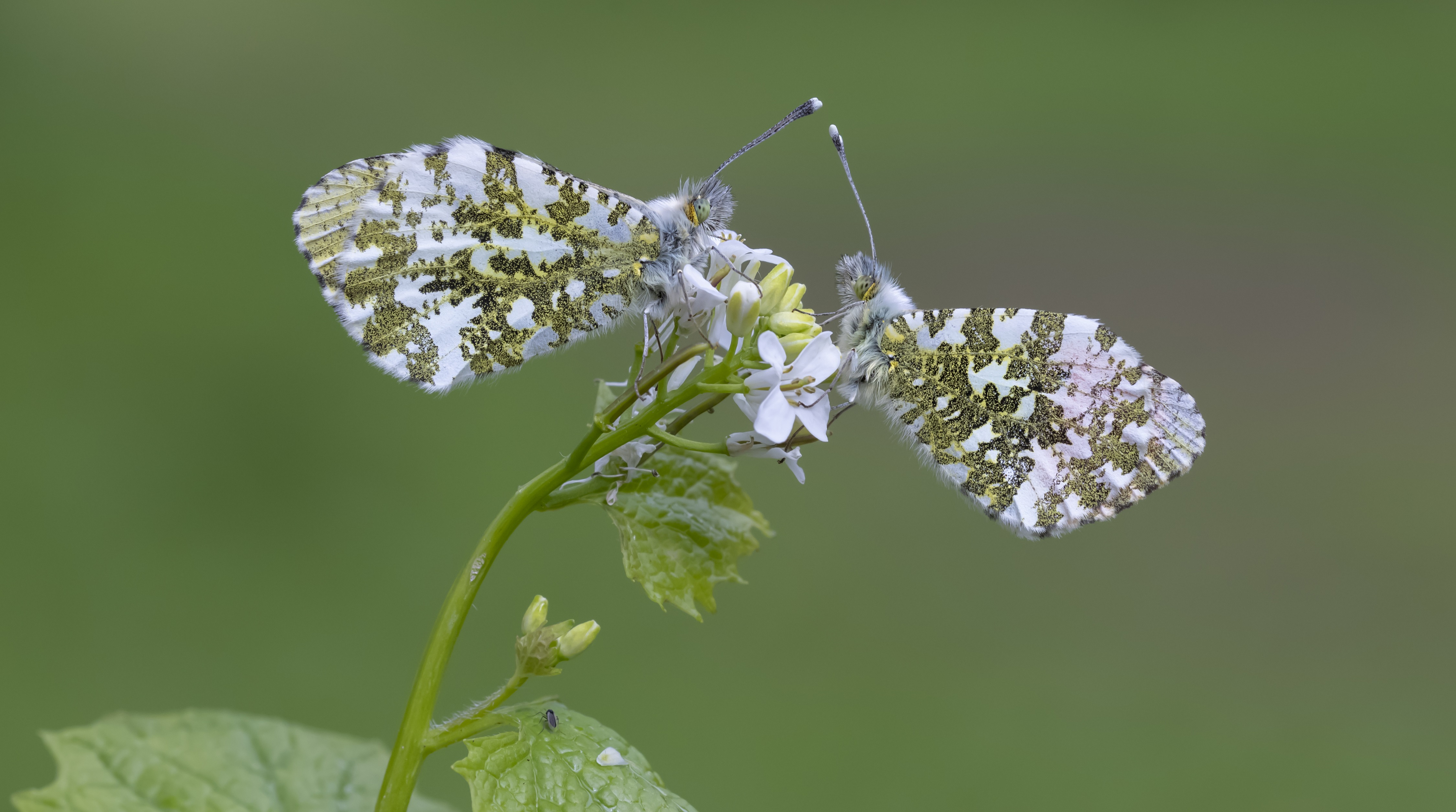
Strangely though, all of my better shots this year of Orange-tips have come from East Sussex. I have always wanted to get shots of the male and female together, and that opportunity came a couple of weeks ago on a cold breezy day. Not ideal for photographing butterflies, accept that when they are asleep they do at least keep still. With the light being so poor I did take quite a few shots to make sure I had some without wind shake and hopefully good focus. In the end I managed around 6 acceptable images that I was really pleased with. Just before the 2nd shot below, the sun almost came out, and that was enough to wake the male up enough for him to show a hint of orange.


Orange-tip pair. (female on left).


A few days later, and I was meeting Nigel in Abbotts Wood. It was only a few days earlier that we had been chatting about how unusual it was to see some types of butterflies mating, and how good it would be to see Orange-tips mating. I can only remember seeing it once, and that was in France!! Nigel too, had only seen it once, several years ago. Anyway, there I was walking to the area where we were meeting, I had already stopped and listened, and seen Nightingales, so I was feeling good about life. I then spotted 2 'white' butterflies about 50 metres ahead of me around a patch of Bluebells. They then descended together and I wondered if it was a pair of Green-veined White or Orange-tip possibly going to mate. By the time I had got to them and seen that they were indeed Orange-tips, they were already attached, sitting in a very nice position on top of a Bluebell. I now just hoped Nigel would hurry up and arrive. Moments later, my phone rang, and it was Nigel saying he was on his way. When I explained what I was looking at, he told me he had just had a mating pair near where he had parked his car!! Anyway, he was then able to see my pair as well, so he had seen 2 mating pairs in around 10 minutes!!

We both took many photos of my pair, and also from both sides. I actually prefer the ones looking into the sun as it really shows off the orange tips to the males' wings.


Mating Orange-tips on Bluebell.


The same pair looking into the light.


Another male Orange-tip hoping to get into the action.


A few more days later and I get lucky again with another male Orange-tip. This time on my local patch, and this time on Garlic Mustard, that this year has been growing in enormous quantities. It was a dullish day, but warm and muggy. The butterfly was awake, but with only a little bit of occasional sun, it wasn't too active. I had taken a few images, when it suddenly showed some of its forewing and a lovely flash of orange.


Male Orange-tip on Garlic Mustard.


Saturday, 27 April 2024

Butterflies Lift My Spirits!!

 Yet another week has just passed with very little warmth, sunshine or calm conditions. In fact many days felt like winter had returned.

Rather than complaining though, I decided to have a long walk through Friston Forest to see if I could find any roosting butterflies. Not an easy task, but rewarding when successful.

What has been very noticeable in the past couple of weeks is the mass of Garlic Mustard, which has obviously taken advantage of the damp cool spring. Garlic Mustard is also one of the main larval foodplants of both the Orange-tip and Green-veined White. Hopefully with all this food for the larvae the butterfly will have a good year and there will be plenty of both these species next year flying.

The slight downside of all this Garlic Mustard is that looking for the roosting butterflies is more challenging, as they can be more spread out. However, I wasn't far into my walk when I saw a very fresh female Orange-tip roosting on the top of a Garlic Mustard flower. 

The light all day was very poor, so I took lots of photos of all my subjects today to hopefully mean I got a few sharp shots. In fact it ended up the most photos I had taken in a single day for a mighty long time!! It was certainly worth it though as I ended up with several pleasing shots.


Female Orange-tip on Garlic Mustard.


After spending some time with this lovely butterfly I moved on seeing very little in the form of butterflies. The temperature was below double figures, so there was absolutely nothing flying, apart from large numbers of Adela reaumerella, a tiny moth with extremely long antennae, so it was just a case of wandering about hoping something would catch my eye. I did take a couple of shots of the female, that has a shorter antenna, as they are quite a nice looking micro moth.


Female Adela reaumerella.

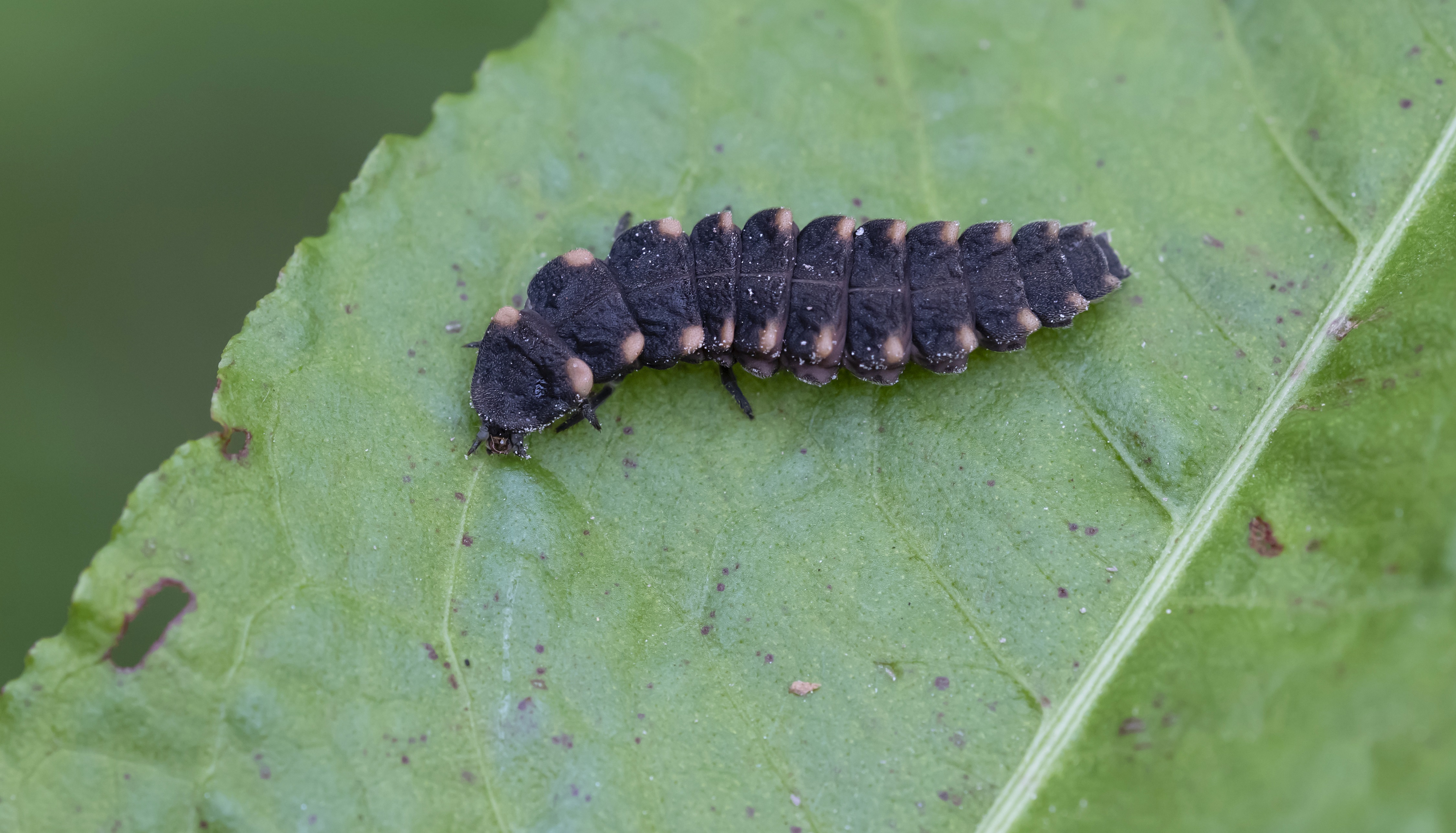
After several miles and little else to see I was pleased to spot a Glow-worm larva crossing the path. I have seen several of these over the past couple of weeks, so hopefully there will be lots of little lights on the Downs in a couple of months time!!


Glow-worm larva.

I was by now halfway back to the car, when I spotted the lovely macro moth, Pretty Chalk Carpet, resting on a leaf in the verge of the forest track. At first I took it as a bird dropping, but after a double take I realised it was a moth. I have only seen a handful of this species before, so was very pleased to find it.


Pretty Chalk Carpet.

A short distance further down the ride I then found a Green-veined White on another clump of Garlic Mustard. Surprisingly, this one wasn't asleep, but nectaring on the flower. It also moved a couple of times giving me other photo opportunities.


Green-veined White on Garlic Mustard.


Green-veined White on young Bluebell.

By now, it was mid afternoon, and it seemed that the weather was not going to improve. I was by now nearly back to where the female Orange-tip had been and I was thinking how good it would be to see a roosting male, when I suddenly spotted one. Although he wasn't as fresh as the female had been, it was still brilliant to see. 


Male Orange-tip on Dandelion clock.

Amazingly by now the sky had cleared a little, but not enough to have woken the female up, and she was still happy on her Garlic Mustard flower. However, when I reached the top of the hill I saw a Green-veined White that had decided to risk a short flight. It very soon landed again though on the edge of a Bramble bush. This gave me my last photos of the day.


Green-veined White.

2 days later and the weather was still miserable, so after enjoying Friston Forest so much I decided to repeat the trip. It was slightly better, with hazy sunshine, but now with an even colder and stronger wind. On the walk I did see several Green-veined White, but no Orange-tips at all. The highlights were 4 Scarlet Tiger moth larvae as well as a couple of moths that I don't catch in my moth trap. A Green-silver Lines and a White-pinioned Spotted. At the furthest end of the walk there were also a superb display of Early Purple Orchids.


Scarlet Tiger larva.


Green-silver Lines.


White-pinioned Spotted.


Early Purple Orchids.

I also had a lovely encounter with a Stoat in the forest. Two days that I wasn't really expecting to see much, turned out to be 2 very worthwhile and rewarding days. However, it really would be nice to get some proper spring weather soon, please!!


Monday, 22 April 2024

Early Spider Orchid fools a Bee.

 It was time for my annual Early Spider Orchid fix, and after getting a call from David, telling me that he and Gary were going to a favourite site of mine, I decided to join them. We also invited Pete to join us, so it was quite a party when we all met up. Once again, the cold breeze that seems to have been with us for so long, was still there, and along the top of the downland it was pretty exposed.

It is quite a long walk to the hillside where the orchids are, so there was plenty of time for a bit of banter, and finding out where everyone had been recently. Japan was the furthest any of us had travelled, and that wasn't me!!

The orchids this year seem to be mainly quite small, which was a bit of a surprise to me with all the wet weather we have been having. It was actually quite hard finding any of the orchids that were in a good position for photography, as most were tucked into the grasses where they were so short. At last though, one of them did stand out as it was a little taller and also at an angle where the background would be blurred out.


Early Spider Orchid.

We had a wander across the area finding many orchids, with many more still to come. As we slowly made our way back Gary and I both saw a small bee drop down onto one of the flowers. Fortunately, we were able to get some quick grab shots of the bee on the flower, as this is how the orchid gets pollinated. The orchid actually has a scent which mimics the pheromone of the female bee, so when a male detects this scent he tries to mount the flower to mate, with what he believes is the female bee. In doing so he is likely to get the sticky pollen sacs attached to him. The idea then is that he will eventually try the same thing on another orchid if he gets fooled again, and pollination will take place. It is only the solitary bee, Andrena nigroaena, the Buffish Mining Bee, that the orchid attracts. I have never seen this behaviour before, and there are not that many pictures of the event either, so we were really lucky to witness this happening in front of us. It was also very quick. I only managed to shoot off 3 photos before the male bee realised he had been fooled, and off he went in a huff.


Buffish Mining Bee (Andrena nigroaena) on Early Spider Orchid.

It was such a great experience that 3 days later I tried again, this time with Lisa. Needless to say we didn't see this happen again, although it was good to see that a few more orchids had appeared. I only took a very small number of shots, but once again, one orchid did look particularly worthy of a couple of photos.


Early Spider Orchid.


Tuesday, 16 April 2024

Orange and Red.

 Lisa has just had a couple of weeks off from her dancing work, which has given us a few chances to get out and about in nature.

During the first week we had an early Green Hairstreak on my patch, this was equal the earliest date I have seen this species. We saw it in a brief sunnier spell and unfortunately the butterfly flew deep into the bushes pretty much as soon as we saw it. However, it was great to get one of these beauties so early. Fingers crossed for many more sightings in the next few weeks.

This past weekend was spent over in West Sussex. The Friday was spent covering 3 sites hoping for Green Hairstreak and Orange-tip. Before we went to the main sites for these we paid a visit to a site for Green-winged Orchids. Although quite early in their season we did find a few nice specimens coming through, and one in particular was worthy of some photos. We also had a very nice male Emperor Moth which gave Lisa her best photo of this species to date.


Green-winged Orchid.


Male Emperor Moth.


The Hairstreak site was very windy and we only saw a single one. However, throughout the day we did see Orange-tips at all the other 3 sites, with many seen in a small wooded section we walked through. At one point I even had 2 male Orange-tips nectaring together. In the same area I also had my first ever sighting of the small plant, Moschatel. This is a lovely little plant that has the nickname Town Hall Clock' as it has 4 sides on the flower with each side looking a little like a clock!!


Two Male Orange-tips.


Moschatel.


On the Saturday we had a full day at one of the Sussex Wildlife Trust reserves at Ebernoe Common. Here we had many more Orange-tips, both male and female. Some interesting observations were also had of the species, with seeing a little bit of egg laying, female rejecting the advances of a male, a female roosting on Cuckoo-flower as soon as the sun went in, and another female choosing to roost high up a tree.


Female Orange-tip resting during egg laying.


Female Orange-tip rejecting the advances of a male.


Female Orange-tip roosting on Cuckoo-flower.

At this site we also heard several Nightingales and our first Cuckoo of the year. Bluebells were looking fabulous, and Early Purple Orchids growing amongst the Bluebells were also good to see. 

We also had our first odonata of the year with a large emergence of Large Red Damselflies. Another damselfly we saw was probably an Azure Damselfly.


Large Red Damselfly.

On Sunday morning we headed to Pulborough Brooks RSPB. Although it was quite busy here we did have a pretty good morning. Once again Nightingales and a Cuckoo were heard. 2 Adders were seen basking in the sun together, and we also had excellent views of a very vocal Sedge Warbler. At this site too there were plenty of Large Red Damselflies emerging.


Sedge Warbler singing away.


Large Red Damselfly.