Followers

Tuesday, 20 August 2024

Feeling Autumnal.

 It is certainly feeling that summer is on the wane already, and that Autumn is very nearly with us. The local downland now is coming into flower with Devil's-bit Scabious and Autumn Lady's-tresses and many of the wild flowers are getting their seed-heads, although most of the trees are still a little way off changing colour.


Autumn Lady's-tresses.


Some of the late summer insects are also increasing in number now, with several Hornet Robberflies being seen, as they hunt smaller insects. As in previous years, grasshoppers seem to be a favourite prey item for them!!


Hornet Robberfly with grasshopper prey.


Female Wasp Spiders and their amazing webs are also now a common sight. These also enjoy a tasty grasshopper for lunch. They even add additional strength to their webs to help stop the grasshopper from jumping away. They do also, of course, take other insects as food. I did see a female Wall Brown in a web recently, and other small butterflies and flies are also taken, and even the male Wasp Spider can be a snack for the much larger female if he isn't very careful.


Female Wasp Spider with small fly.


Female Wasp Spider hanging around..


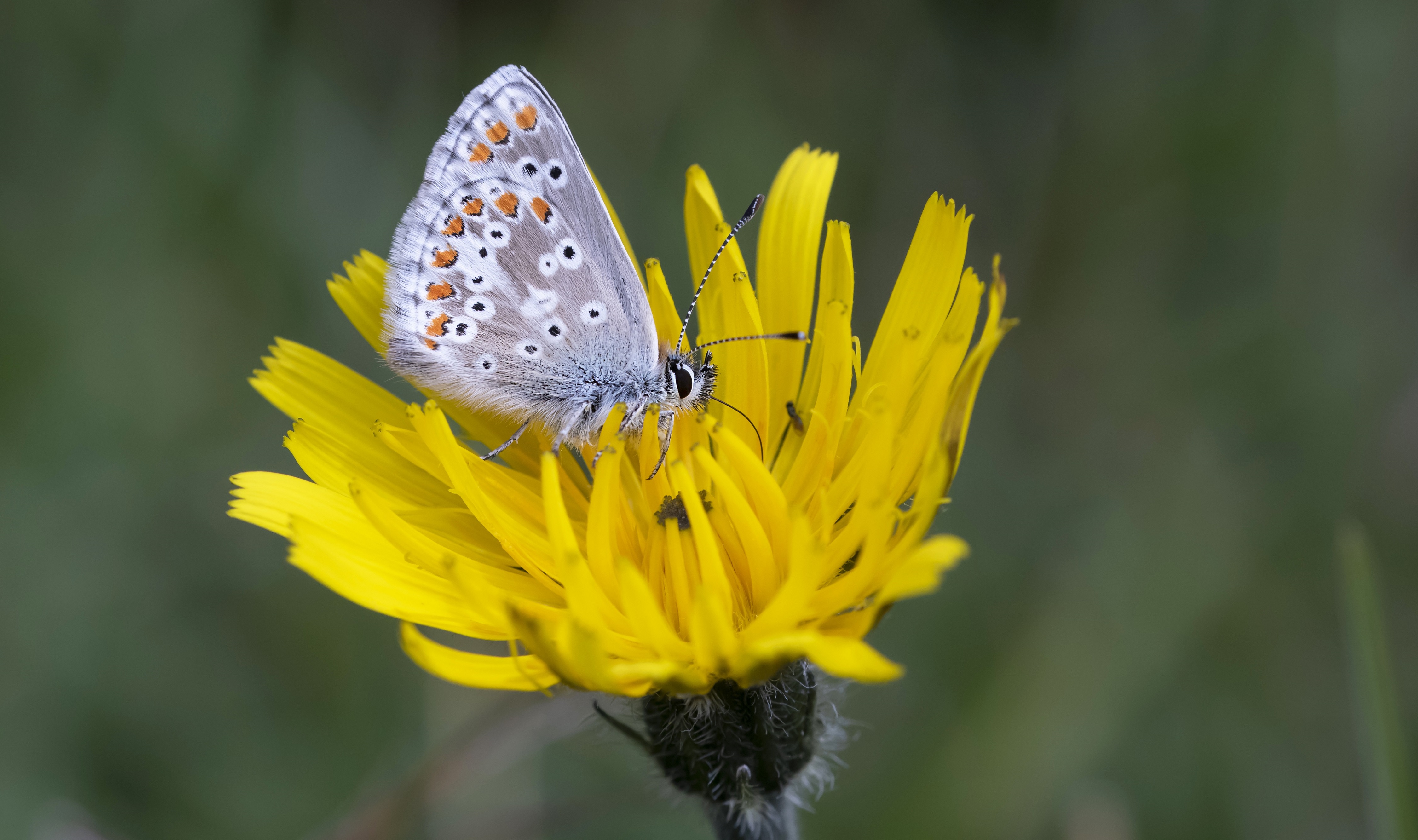
A little later this year, which seems to be a trend, the Adonis Blue butterflies are now starting their 2nd brood. I saw my first 2nd brood last week on Wednesday, just a single one seen, but now already numbers have grown at the same site to around 50. Hopefully many more to come still. On a very breezy and dull afternoon, I found several going to roost. The breeze made it very difficult for photography, but eventually a slight lull in the breeze allowed a few attempts, however, only one effort was worth keeping.


Male Adonis Blue.


Sunday, 11 August 2024

Iping Silver-studded Blues.

 Going back in time to when Lisa and I returned from our epic Scotland trip, the day following our return, Lisa was busy, so I was heading back to Seaford.

However, as I had missed seeing the Silver-studded Blues in 2023, and as I was already halfway to the site, as I was in Worthing, I decided that it would be a great opportunity to head to Iping Common, near Midhurst, to catch up with this delightful butterfly.

I would have liked to have got there at the crack of dawn, so I could try to find them at roost, but as the weather was not going to be amazingly hot, with quite a bit of cloud, I thought I would probably see them at roost some of the day anyway.

Seeing reports from across the country, it seemed that the Silver-studded Blue was actually having a reasonable year, unlike most species of butterfly.

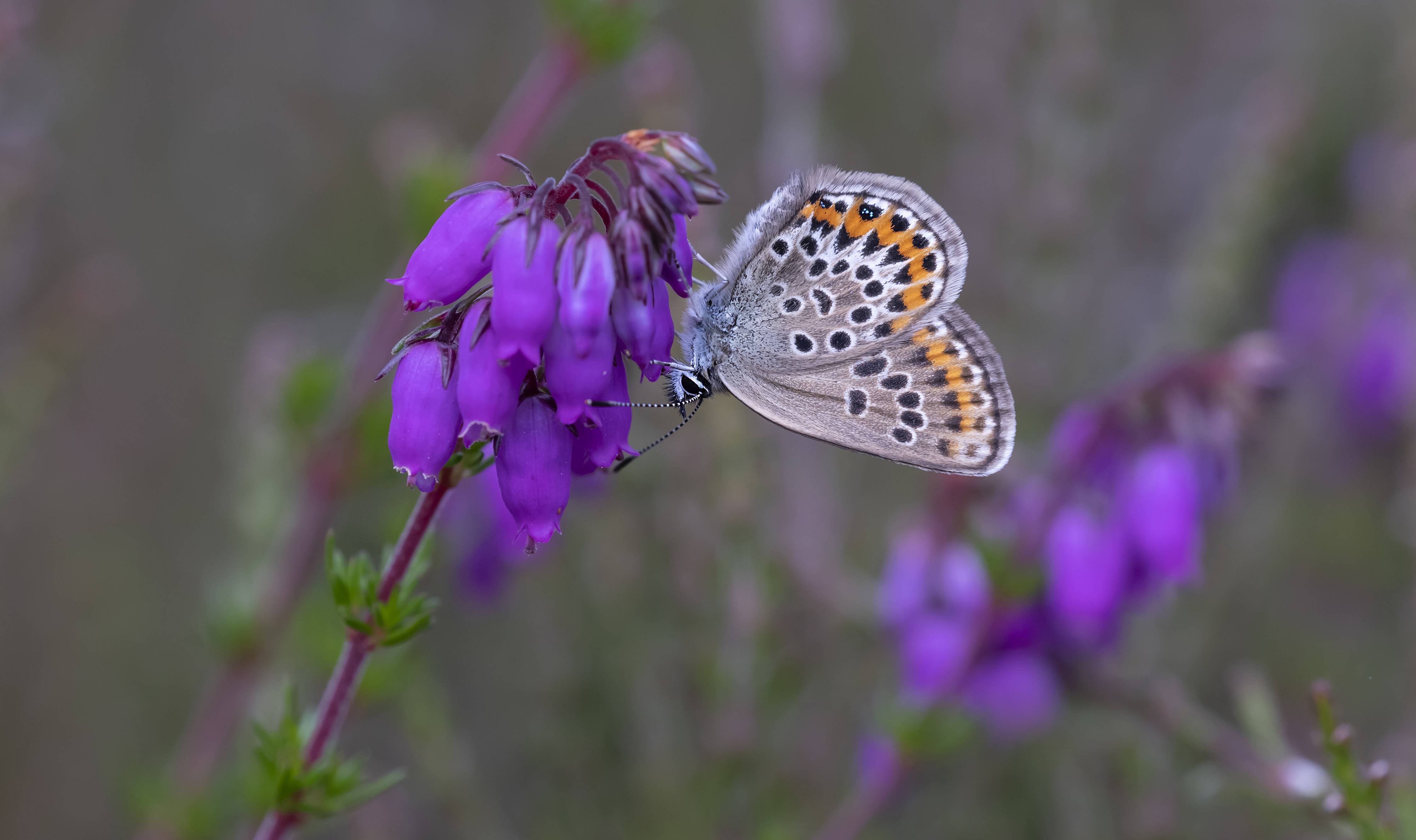
I headed straight away to an area where I have seen the butterfly in years gone by, and it wasn't long at all before I started to see some of them flying low over the heather. I was really hoping to see a mating pair, but alas, that was not going to happen. Most of the butterflies were very flighty, despite the weather, but I was soon photographing a female butterfly that was sticking to a small area as it nectared on the heather.


Female Silver-studded Blue.


Occasionally the butterfly would pause and open its wings to gain heat from the sun through the light cloud cover.


Female Silver-studded Blue.


I actually spent around 30 minutes with this individual, as it gave me many opportunities to photograph her. Both as she carried on nectaring and then basking open winged.


The same Female Silver-studded Blue.


Eventually, I left her in peace, and headed further along the path. As usual here, the butterflies were often in small groups, and it was after leaving the main path, that I found a male that allowed a closer inspection.


Male Silver-studded Blue.


After a longer walk around the common, I was back to where I had started with the female. By now she had moved on to another area, but I was then treated to a very fresh male butterfly. He was nectaring on the heather, giving me the odd opportunity. Not quite as confiding as the female, but still very nice.


Male Silver-studded Blue.


By now heavier clouds were building, and eventually the male went to roost in the heather. On looking up to the sky, I could see that lighter clouds were coming soon, and as they arrived, the male opened his wings quite wide to show off its beautiful blue top wings.


Male Silver-studded Blue.


It was fabulous being able to catch up with these butterflies after not seeing them for a couple of years. I was very lucky that the weather helped, by not being too hot and sunny, and it was also good to find some in immaculate condition.

A couple of weeks later, Lisa also had the opportunity to seeing some Silver-studded Blues, at the other main Sussex site on Ashdown Forest. By now these were not quite as fresh, but still not bad. The weather however, was not at all good, with cold strong breezes and even some light rain. I ended up not taking any photos, not actually that unusual, but Lisa did get some nice images.


Saturday, 3 August 2024

Blue Eyes.

 My last blog post about Dragonflies gave me a little inspiration, as I have probably been neglecting this group of insects recently. 

Last weekend I gained further inspiration, when Lisa and I were on Pevensey Levels, and I found a rare Lesser Emperor, as well as seeing a Norfolk Hawker.

3 years ago I found a breeding area for the gorgeous Southern Migrant Hawker, also known as the Blue-eyed Hawker, within walking distance from home, and with this recent extra interest I decided to go and have a look at the site to check if the dragonfly was still using the area. More of that later!!

It was back in 2017, when the Southern Migrant Hawker came on my radar. The only really reliable site for the dragonfly back then was in Essex at Canvey Island. I had never been to Canvey Island, and I had also never 'twitched' a dragonfly before, but when Matt said he was going to Canvey to see the dragonfly, and invited me along, well, it was not an opportunity to miss. We arrived so early, we had to wait a while to see the insect, as they were all still hiding at roost, but eventually some started to fly, and what a stunning dragonfly the adult male is!!


Male Southern Migrant Hawker. Canvey Island. 14/7/2017.


It was 3 years later that my next sighting of the species happened, and that was amazingly in my garden!! I was in the back garden, when I spotted quite a small dragonfly fly across the garden and land on the mass of Ivy that covers the fence. I knew it was different, and I had no idea at that moment what species it was. I ran upstairs to grab the camera and got back in the garden, but I stupidly hadn't made a mental note where the dragonfly was actually sitting. I panned the area and eventually spotted it. After taking a few images, I was then able to check the dragonfly books. I was amazed that it was a teneral (immature) Southern Migrant Hawker. Possibly the first sighting for Seaford? And it had chosen my garden!!


Teneral Southern Migrant Hawker. Seaford 6/7/2020.


This species when it emerges from it's larval underwater life into a dragonfly, it will leave the area where it emerged until it is fully mature. This means that teneral dragonflies can literally turn up anywhere within a few miles of the breeding area. I was so lucky that it chose my garden to rest. Even more amazingly perhaps was just last year, 2023, I had another one hunting for insects over the garden. My garden is obviously in the area that they mature in.

My next encounter came in 2021, when James and I were searching for Scarlet Tiger moths in Friston Forest. We were walking along a ride that held a few of the moths when we spotted a teneral Southern Migrant Hawker. Fortunately, it flew only a very short distance, and we were both able to get some nice photos of it. We did see several more of them over the next couple of weeks and it was clear then that the species was becoming more numerous in the Seaford area.


Teneral Southern Migrant Hawker. Friston Forest. 11/07/2021.

Only 4 days after seeing this one I then found another in a private wood near Ringmer that I survey for butterflies.

Just over a month later was the day that I found the breeding area for the species, close to home in the Cuckmere valley. This was a day that I will never forget, as it was a very sad day for me, as it would have been Penny's birthday, the first one since I had lost her in April. 

The local Lace Border had already tried to cheer me up when an extremely fresh individual had sat perfectly for me giving me what is still by far, my best photo of this stunning little moth. (maybe the moth knew that I needed to be cheered up, or maybe Penny's spirit placed it there for me)!!

 So to then find the breeding area of a rare dragonfly just 40 minutes later, I was in a much brighter mood when I got back home!! I also managed to get a few half decent flight shots. Of course by now the dragonflies were fully mature with the bright blue eyes that gives them their alternative name.


Male Southern Migrant Hawker. River Cuckmere 16/8/2021.


A week later I visited the site again and found a male at rest. Something that the mature adults rarely seem to do!!


Male Southern Migrant Hawker at rest River Cuckmere 23/8/2021.


What is probably my best image of a teneral then came in June 2023 along Cradle Valley when I was actually looking for Norfolk Hawkers, which had also by then reached this part of the country. I saw the dragonfly in flight and realised what it was before it landed this time. I was lucky that it landed head height, as after taking the photos it next landed much higher in the bush and well out of reach.


Teneral Southern Migrant Hawker. Cradle Valley 18/6/2023.


So, we now come to this past week, when I have had 3 sessions with the dragonflies at the local breeding area. Up to 10 males have been seen as well as possibly 3 females. Twice in tandem with males. It certainly is a challenge photographing them in flight as they are constantly moving about at high speed, only occasionally hovering in one spot for a second or two. Unless you are in exactly the right spot you have no chance. But, one did hover in the right area on each occasion, giving me the fighting chance I needed. There is still plenty of room for improvement, so fingers crossed for next time.


Male Southern Migrant Hawker in flight. River Cuckmere. 30/7/2024-1/8/2024.


After the final photos were taken, the weather clouded up and I started looking for them at roost as they had stopped flying. Eventually I found one sleeping on a Blackthorn bush.


Male Southern Migrant Hawker. River Cuckmere. 1/8/2024.


I have really enjoyed the days spent with this stunning dragonfly, and the challenge of photographing them. They have increased in number so quickly in the Seaford area, and it's well worth looking out for them in both their immature stage, right through to seeing them with those incredible 'Blue eyes'.


Monday, 29 July 2024

Norfolk Comes to Seaford.

 For the 2nd year running, there has been a very big influx of the lovely Norfolk Hawker dragonfly into the area around Seaford. 

The first one that I saw this year was on the 23rd May, in nearby Friston Forest. In fact, most of my sightings this year were in that forest, but similar to last year, there were also sightings on the downland at the back of the town.


Norfolk Hawker. 23/5/2024.

A whole month later, Friston Forest was alive with this dragonfly, with most of the rides holding a few maturing dragonflies. Similar to other dragonflies, the Norfolk Hawker will leave the breeding ditches just after emerging from their nymph stages, into the dragonfly that we see flying around, until they are fully mature, at which time they will return to the ditches to breed. 

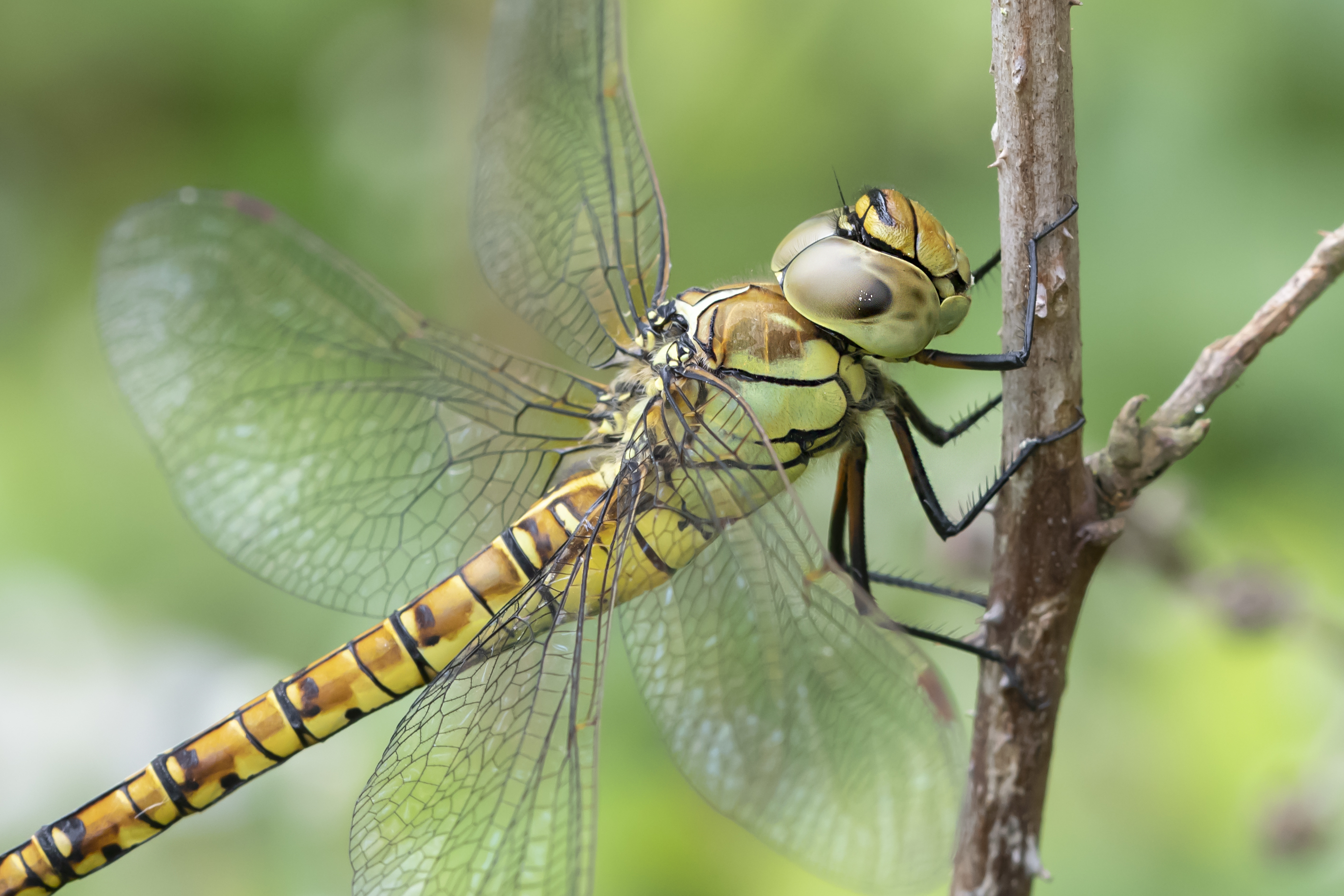
By the time they have reached full maturity, the eyes will have turned a brilliant green colour. This gives the dragonfly, it's alternative name of the Green-eyed Hawker.

On the 26th June, I saw around 20 of these impressive dragonflies in Friston Forest. Very few settled, but after a very long wait, one did eventually stop and rest in an area that I could photograph it.


Norfolk Hawker 26/6/2024.


Another species that is colonising the area is the Southern Migrant Hawker. Instead of green eyes, this one when mature has vivid blue eyes. Not surprisingly, this one has the alternative name, Blue-eyed Hawker!! Once again, this species spends time in local woodland and hedgerows until they are fully mature. This is a smaller species than the Norfolk Hawker.


Southern Migrant Hawker.


On the butterfly front, another East Anglian named species, the Essex Skipper have been quite numerous on the Seaford downland. This species is very similar to the more common Small Skipper. They are best told apart from the very evident black tips to the antennae, when seen from the front of the butterfly. I photographed one recently on Bird's-foot Trefoil, from the angle that shows this off. After looking at the images I noticed that this individual had picked up some pollinia from the abundant Pyramidal Orchids. The pollinia was certainly causing issues for the butterfly as it was trying to clean the pollinia from its proboscis.


Essex Skipper. 2nd image showing the butterfly trying to clean its proboscis.


A Pyramidal Orchid. The pollinia would almost certainly have come from one of these.


Currently on the downs at the back of Seaford, the Chalkhill Blue butterflies are flying in large numbers. They emerge from their pupae during mid July to mid August. Whilst surveying the area I recently found a male Chalkhill Blue that had yet to fly. It had crawled up a small grass stem and was expanding its wings when I found him. 


Male Chalkhill Blue before its maiden flight.

It is quite easy finding mating pairs of Chalkhill Blues as well, as often the female is intercepted by a male as she emerges, and often they are joined together before she has even flown.

The female Chalkhill Blue is brown, so quite different from the pale milky blue that the male is on the top wing.


Mating Chalkhill Blues. (female below).


Thursday, 25 July 2024

Success in Cumbria.

Following our fabulous trip to Mull, Lisa was keen to add to her butterfly list, so as we would be driving south through Cumbria, we decided that we would have a few days based in Kendall to see if we could see some of the specialist species that occur in that area.

I had only seen the butterflies here once before, when Nigel and I visited the area back in 2011. The species we were to target were the Large Heath, Mountain Ringlet and Northern Brown Argus. 

Once again, the weather forecast was not particularly brilliant, but as we had such great success in the Fort William area in poor weather, this didn't put us off.

After the drive south from Mull, stopping briefly to see my brother, who lives near Glasgow, we got to Kendall quite late in the day, so all thoughts were on the following day, and a visit to Meathop Moss. This is the same reserve that Nigel and I visited in 2011. After such a long time, it was good that I still recognised the parking area, although the footpath to the site didn't seem familiar. However, once we reached the boardwalk, it all came back to me. 

The weather was, as forecast, pretty awful. As we walked around the boardwalk I somehow spotted a very fresh Large Heath in amongst the Heather. Just after spotting the butterfly a very heavy rainstorm, complete with a single, very loud clap of thunder hit us. After sheltering for around 40 minutes the rain eased enough for us to venture back out, hoping that the Large Heath would still be there. Not that it was likely to have flown away in the rain!!

It was still where we had last seen it. An absolutely stunning butterfly, and so much nicer marked than the last Large Heath I had seen in Scotland. Large Heath have 3 different forms in Britain. In Scotland the form scotica have very few wing spots and looks like a large Small Heath. Further south is the form polydama which have more wing spots, and finally, the form we were looking at, davus, which have even more distinct wing spots, and is the most impressive form.


Large Heath. 

I guess neither Lisa or I expected to find any butterflies on such a horrible day, but as we had found it, and it wasn't going to fly far, we could get several photos!!


Such a stunning butterfly.


Large Heath. (Form davus).

A couple of days later, in better weather conditions we returned. This time we saw several Large Heath, but all were very flighty and difficult to approach and none of them were as fresh as this individual, so we realised how lucky we had been to find this beautiful specimen.

After Meathop Moss we headed to Arnside Knott, but after arriving in yet more heavy rain, and eating lunch in the car watching the rain getting even heavier, we called it a day on the butterfly front and headed to the nearby Leighton Moss RSPB reserve. Here we were amazed at the masses of Swift that were feeding above the reed-beds. We also heard a booming Bittern.

The following day we headed back to Arnside Knott, in the search of Northern Brown Argus. The weather was today, much improved, although quite wet in the long grasses. It wasn't long before Lisa and I saw our first Large Skipper of the year. This was followed by a few Small Pearl-bordered Fritillaries, as the sun had started to appear through light cloud.

After a couple of hours of searching I spotted our first Northern Brown Argus. This superb butterfly was extremely fresh, and quite flighty, but at least it was keen on nectaring on the few flowers in the small hillside meadow. It was also very loyal to the immediate area, so we had several opportunities to photograph it. I must confess, I wasn't confident that we had a Northern Brown Argus, as it looked very much like the Brown Argus we get in Sussex. However, I have been assured that the normal Brown Argus, that is gradually heading north, hasn't got to Cumbria yet, so it has to be a Northern Brown Argus!!


Northern Brown Argus nectaring.


Northern Brown Argus.

After spending some time with this beautiful butterfly, we continued our search for more. It certainly took a while, but eventually we did see 2 more Northern Brown Argus, and these 2 were without doubt the Northern variety. Although they were not particularly fresh.

On the way back to Kendall, we called into Latterbarrow, a delightful small reserve that was filled with wild flowers. However, it was disappointing that there were not that many butterflies on the wing. Another enthusiast there said he had seen 3 Northern Brown Argus, so we started another search. By now the day was moving on, and it looked as though we may not see much. Just a single Small Pearl-bordered Fritillary was seen, until I disturbed a Northern Brown Argus.


Northern Brown Argus.

Not long after this the weather once again went downhill, and light rain started to fall. I was still keen though to keep searching to see if I could find a roosting Argus. 
No Argus were found, but I did find an absolutely fantastic Four-spotted Chaser dragonfly. This was one of my highlights from the whole trip, as although these are quite a common dragonfly, this individual was an amazingly beautiful individual which gave us some lovely photos despite the fact it was drizzling as we took the pictures.


Four-spotted Chaser.


On our final full day in Cumbria, we headed to Irton Fell to hunt out the Mountain Ringlet. I had never been to this site before, but I was told it was the most reliable site for the species. Back in 2011 Nigel and I had gone to a site in Langdale for the butterfly, but to be honest, I would find it difficult to remember where to go there. On the plus side, there had been sightings at Irton on the Cumbria BC sightings page already, so we at least knew that the butterflies were on the wing.

On the walk up the fell, we did struggle, after going wrong a couple of times, but eventually we did make it to the grid reference, where the previous sighting had been made. As we approached the area I spotted a Mountain Ringlet. Wow, that was easy!! Lisa managed a couple of grab shots, before we watched it fly around 30 metres away, only to vanish in the deep grass tussocks. We then spent the next 4 hours or so, wandering around hoping to see it again. Now it didn't seem so easy!!

In the end, we decided we didn't have the strength to go on, so we descended back down to the car, rather disappointed, but also trying to be positive as we had at least seen one. We saw 2 other couples whilst we were searching, and neither of them had even seen one, so it could have been much worse!!

As I didn't get the chance of a photo of this butterfly, I am including a photo of a female from way back in 2011. 


Female Mountain Ringlet from 2011.

On the way back to Kendall we called in for a walk around the boardwalk at Meathop Moss. This is when we saw up to a dozen Large Heath. Although they were very difficult to approach. It was encouraging though, to see the species still doing well at the site, thanks to some excellent management there.

The following morning, we were reluctant to leave, so we treated ourselves to one final visit to Latterbarrow. To get back to Sussex at a sensible time, we allowed ourselves a couple of hours. As it was better weather and earlier in the day from our previous visit, there were more insects active. However, it was still a while before we got lucky. By this time, we had been joined by another enthusiast, Mark Holmes, who was visiting from Norfolk. After a short chat he had just started to wander off when I put up the first Northern Brown Argus of the day. I quickly called Mark back to where I was watching the butterfly. It was quite amazing really, as Mark had only seconds before said to me, 'Give me a shout if you see a Northern Brown Argus'.


A Latterbarrow Northern Brown Argus.

All 3 of us enjoyed watching and photographing this lovely butterfly, before it was joined by another one. We then had the choice of 2 butterflies to watch.


Northern Brown Argus.

And so ended over 3 glorious weeks away with Lisa. To say it was a successful trip would be a massive understatement. All our main targets were achieved, apart from perhaps the White-tailed Eagle, although we did at least see some of these.

As we left, Mark Holmes was at the beginning of his few days in Cumbria, and he reported to me later that he saw lots of Mountain Ringlet higher up Irton Fell than where we had been. If we hadn't seen that Mountain Ringlet as soon as we had arrived, we would also probably have gone higher, and would probably have found this higher colony. Still, on the bright side, we can go back again in a year or two!!