Followers

Thursday, 27 June 2024

Small Pearl-bordered Fritillaries.

 On our 2nd morning in Scotland, before the rain, we were photographing the beautiful Chequered Skippers at Glen Loy, when a fabulous flash of orange caught my eye. It was a stunning male Small Pearl-bordered Fritillary warming up in the weak sunshine.

In Sussex, the Small Pearl-bordered Fritillary became extinct in 2013, and although it has since been re-introduced, it is really struggling in the long dry summers. However, in Scotland, it remains a common butterfly. It is always rewarding seeing a butterfly as beautiful as a Small Pearl.

I quickly called Lisa over, as it could possibly have been the only one we saw, bearing in mind the weather forecast for the remaining 3 days before we were to head to the Isle of Mull. It was a very fresh male and as it was warming up, we had a few minutes to photograph it before it took to the wing.


Male Small Pearl-bordered Fritillary.

Just after it flew we went back to the Chequered Skipper, but it wasn't long before we saw a couple more Fritillaries flying around. A little while after, the torrential rain appeared and we took shelter in the car. 

Some time later, the rain eased off and we were able to resume our searches. We decided to head to the other side of the road bridge, an area where I had success when I was here before with Nigel. It wasn't long before Lisa spotted another Fritillary at roost on the Bracken, and then another that was roosting on a Bluebell. With another improvement in the weather the butterflies did start to become a little more active, before then deciding it wasn't going to improve enough, so it was back to sleeping.


Small Pearl-bordered Fritillary on Bracken.


Small Pearl-bordered Fritillary on Bluebell.

With the weather starting to deteriorate further we headed back to Fort William.

The following day at Allt Mhuic butterfly reserve, we did see yet more Small Pearls, although I didn't take any photos of them, however, on our last full day on the mainland, the visit to Glasdrum Wood was very notable for this lovely butterfly. With the Chequered Skipper past their best here it was the brilliant Small Pearls that made the day. Some of them, especially the females were in excellent condition, and as the weather, especially during the morning was still cool and cloudy, many of them were a bit sleepy!!


Female Small Pearl-bordered Fritillary on Bracken.

After having lunch on the bench overlooking the loch, the weather improved quite a bit, so we headed back to the main path and enjoyed watching and photographing many more butterflies.


The freshest female Small Pearl-bordered Fritillary that we saw.


It was whilst we were trying a slightly different approach to photographing the fritillaries, that I spotted a mating pair on the Bracken. Strangely, I can't remember seeing a mating pair of this species before. Certainly if I have I haven't photographed them. It was the last and biggest highlight of a fabulous day at Glasdrum Wood.


Mating pair of Small Pearl-bordered Fritillaries. (male on left).

I would guess we saw between 20 and 30 Small Pearls at Glasdrum as well as a couple of the earlier flying Pearl Bordered Fritillary.

During the rest of our holiday, both on Mull and in Cumbria, we did see a few more Small Pearls, but by then we had our sights on other species.


Monday, 24 June 2024

Chequered Skippers from Scotland.

 Lisa and I have just returned from a great trip to the Isle of Mull. As our timing was spot on for some of the northern butterflies, that Lisa had never seen, and I have only seen most of them once before, we decided to add a few days at both ends of the trip, to give us the chance of seeing and photographing them.

The first 4 days we were based in Fort William, the mecca area for Chequered Skippers. This species became extinct in England many years ago, although it has recently been re-introduced from continental stock. However, to see the genuine British butterflies in their home is for me, and Lisa, much more appealing. We decided on allowing 4 days just in case the weather was not looking good, and it is just as well that we did, as the forecast for all 4 days was for heavy cloud and rain, with just the odd sunnier intervals. At least it wasn't windy though.

We arrived in Fort William late afternoon in cloudy conditions, but with the odd sunnier bit, I suggested we should get over to Glen Loy, the most local site straight away, as it could possibly be the best weather of the 4 days. Already it was a bit late in the day for butterflies to fly, as it had got a bit chilly in the dull conditions. As we started to walk along the riverbank we did see plenty of insects, but they were all midges!!

After about 15 minutes of searching, I spotted our target, roosting on a reed. What a moment it was, seeing a Chequered Skipper just sitting there asleep. Lisa was thrilled as this was the first of a possible 4 new species for her.


Sleeping Chequered Skipper.

We really enjoyed the moments photographing this beautiful Skipper.

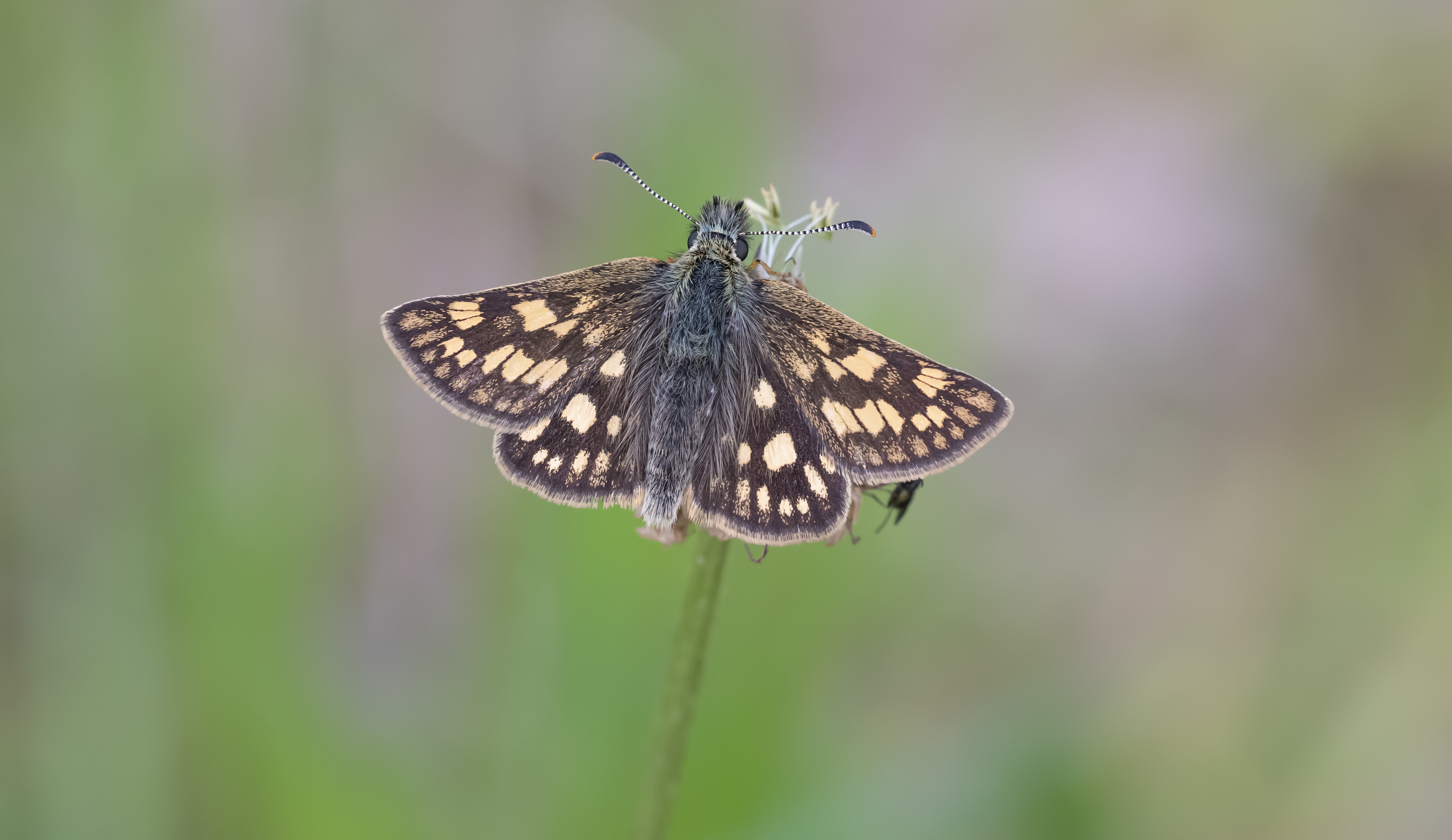
Lisa, being Lisa, really wanted to find her own butterfly. Fortunately, the sun actually made a short appearance, which woke the original butterfly up. She flew a bit before opening her wings briefly, before the sun quickly went behind more clouds. However, in that short window, Lisa did spot another Chequered Skipper that took to the wing. This one too was a very fresh female.


Female Chequered Skipper.

Lisa also found a very nice Green-veined White at roost. The Scottish Green-veined Whites are much stronger marked than the English butterflies. This showed up very well when I was able to photograph it with the sun shining through the wings, in a short window of brighter conditions.


Green-veined White.


We shortly departed back to our superb pod, that we were staying in, so pleased with what we had achieved so early in the trip. Lisa though, had so many bites on her forehead from the midges. She almost looked like she was suffering from chickenpox!!

The 2 Skippers we had found were asleep again when we left them that evening. The following day, the weather was actually a little better than forecast, so we decided to go back to Glen Loy to see if we could find any more Skippers and to see if the females from the evening before were still there.

One of the females from the previous evening was still in the same position, so we left her in peace, hoping that when the sun came out, she would open her wings wide for us. Meanwhile we set about hunting for more along the river. 

Eventually, we started to find some males. These were much more worn than the females we had found. In fact, during the whole 4 days we didn't see any fresh males, whereas every female we found was in fantastic condition. Most of the males were roosting very near to the water, and generally they were sleeping on Bluebells.

When, at last the brightness turned up, we were ready near the female from the evening before. First with some under-wing shots, and then as she gradually opened her wings to gain some heat we managed some nice open wing shots.


Female Chequered Skipper.

We also had our first Small Pearl-bordered Fritillaries of the trip, and Lisa had one of the best finds of the whole holiday, with an emerging Narrow-bordered Bee Hawk-moth, but more of both of those in later posts!!

Just after photographing the butterfly in brighter conditions, the heavens opened and we took shelter for some time in the car. Lunch was had further along the valley where we had been told a Whinchat was showing well. There was no chance of seeing that as we couldn't even see out of the window in the torrential rain. Eventually the rain did stop, and a bit of exploring in the new area gave us another Chequered Skipper.

The following day, we woke up again to poor weather, well, poor if you want to go looking at butterflies!! With the possibility of slightly brighter conditions later, we decided to go and check out the Neptune's Staircase, which is a group of 8 locks on the Caledonian Canal, just on the outskirts of Fort William. We had started to walk along the canal above the locks when the sun briefly appeared. Straight away, a few Damselflies appeared, and then just a few hundred metres beyond the highest lock, I spotted a Chequered Skipper. I never knew that they could be found along the canal. I guess it was a wanderer from a colony not too far away.

Moments later, it started raining again!!

After getting back to the car, wet again, we headed along past Glen Loy, to Allt Mhuic, a Butterfly Conservation nature reserve. Whilst we were at Allt Mhuic, the weather did start to improve slowly. Not far into the reserve we started to see lots of Chequered Skipper. Mostly males battling over territory. We also had a few dragonflies, including a splendid Golden-ringed Dragonfly. As we climbed up the hill beyond a gate, we had another great session with another beautiful female Chequered Skipper. After following it for a short distance, I managed to get a couple of nice pictures as it opened its wings fully, sitting on some foliage.


Female Chequered Skipper.

After a while we headed back to the area near the entrance, where all the battling males had been seen. They were still very active, and Lisa got some great video of them nectaring and battling away.

I then disturbed another female Skipper that flew to the far end of the area and started to roost sitting on a tall seed-head. Meanwhile, I had spotted a Green Tiger Beetle that was hunting on a large rock. I rarely get photos of these very active beetles, but this one was staying loyal to the rock, so for once I could get some close shots of it, showing off the gorgeous colours of green and purple.


Green Tiger Beetle.

Lisa then found a male Chequered Skipper roosting high up. This, although not particularly fresh, was probably the best of the males that we saw, so I have included one shot of him here.


Male Chequered Skipper.


As the afternoon went on, blue sky appeared in the distance. It seemed to take forever to come nearer, but eventually we were actually standing with the sun beaming down on us. By now time was getting on, but it was enough to get the butterfly to once again, gradually open her wings.


Female Chequered Skipper.

The following day, we went to Glasdrum Woods, the most well known of the Chequered Skipper sites. Although we saw a few skippers here, most were well past their best, so I didn't take any photos of them here. It was still a very worthwhile visit though as we did see a few other delights, that will be in a later post.

All in all, we were absolutely delighted with our Chequered Skipper moments in Fort William. My only sightings of this butterfly before was when Nigel and I visited the area in 2015, so another visit was definitely due. The weather on that trip was much better, but despite the rain and cloud Lisa and I surpassed our expectations!!

More from our Scotland trip soon.


Thursday, 20 June 2024

Sussex 'Spring' Butterflies.

 A few days before I was heading to Scotland for a long photographic trip with Lisa, I had my Naturetrek tour, The Spring Butterflies of Sussex.

Unfortunately, the weather was not at all kind to us. It's always a problem when the hotel has to be booked and the van hire is sorted, but the weather has other ideas.

However, we always try our best and in the difficult conditions many rare butterflies were still seen and everyone seemed happy with the results.

The day before the trip I did a quick recce at one of the local river sites to see how the insects there were doing. It gave me some encouragement that we would at least see some lovely insects there.


Mayfly.


Beautiful Demoiselle.


Thick-thighed Flower-beetle.

The following day, I was able to show the group several Mayflies and some of the aptly named Beautiful Demoiselle.

When I am leading a group, although I carry my camera, I rarely use it. This is of course, because my job is to find things for the group to admire and photograph. Therefore, I have only a few images taken during the tour. These are from the 2nd day in the field where we scored with our two main targets. The rare Duke of Burgundy and the rarer Wood White.


Duke of Burgundy.


Wood White.

It is always a wonderful experience showing people new species, and our group was mixed with experienced butterfly watchers as well as a couple of people that were new to butterflies. Even the experienced watchers had the Duke of Burgundy and Pearl-bordered Fritillaries as new species, so it was a very rewarding tour.

The final day was unfortunately, a complete wash-out. This was after opening the moth trap in my garden, where a few moths had bravely ventured out the previous night.


Tuesday, 21 May 2024

Double Delights In Kent.

One of my favourite places to visit, is deep in the Kent countryside in May. Although I have Duke of Burgundy nearer in West Sussex, I love seeing them in woodland habitat, and there is always the chance of some interesting and rare moths, deep in the Kent woodlands. In fact, the main target these days on my Kent visits, is the chance of encountering my favourite little micro moth, the Anania funebris, also known as the White-spotted Sable. This moth is now probably extinct in Sussex, with the very last sightings in the county being in 2018, when Mike Mullis and myself both saw singles at a private wood that we survey. 

I love visiting this area of Kent so much that this year I have done it twice. The first visit was with David. It was also my birthday, which was also the first day of me officially being a pensioner!!

The weather was actually perfect, with our arrival being in overcast conditions, but as we got to the area with the Duke of Burgundy, the sun started to show through, which meant the butterflies started to appear. The first of which was a male Duke of Burgundy that I spotted in less than a minute of us arriving on site.


Male Duke of Burgundy.

Moments later David spotted a female that was basking with her wings wide open. We both managed to get several images of her as she fluttered about. It was so lovely getting these opportunities so early in the day.


Female Duke of Burgundy.

As the day was now warming up quickly, the butterflies became more active, so we started to wander about. We did come across several lovely Fly and Lady Orchids.


Fly Orchid.

I also spotted the first Anania funebris. We both followed the tiny moth for a few minutes, and tried to photograph it as it sat briefly several times, although we never really stood a chance. This species is extremely difficult as it mostly hides under leaves and seems to sense any movement, so it is constantly flying off again. It very quickly vanished, and despite searching in the area, we never did see that one again!!

We then headed away from the main site, to another area up the hill. Here David spotted another micro moth that I don't think I've seen before. The Ancylis unculana is rare in Sussex, only found in a few sites in West Sussex, so it was a really nice find. Unlike the Anania funebris, it also just sat there for us to photograph it.


Ancylis unculana.

Not long after this, I spotted another Anania funebris. Once again, the moth gave us the run around. It was in terrific condition, and as it was my main target for the day, I was really keen not to lose this one. Once again it kept hiding under leaves and flying off whenever we got within a few feet of it. It was beginning to look like a lost cause. Just before we gave up though, it sat for a longer time under a leaf, and I very carefully turned the leaf over, expecting it to fly as soon as there was some movement, but amazingly it actually stayed on the leaf. Although I was holding the leaf with one hand, we both managed to get a few shots of this beautiful rare moth.


Anania funebris (White-spotted Sable).

Following this success, we decided to head off to visit a site for the Man Orchids. However, before we left we did enjoy watching more Duke of Burgundy and Green Hairstreak and also admiring the Lady Orchids.


Lady Orchid.

At the downland site for Man Orchids we came across a very fresh Holly Blue. Although these blues are common, I rarely get them in a position to photograph them. As it was now very warm, the butterfly wasn't going to open its wings, but it was still nice to see it close up.


Holly Blue.

The Man Orchids were unfortunately, not fully in flower, so we didn't spend too much time with them. The long drive home though, was made easier knowing we had had an extremely good day!!

I actually enjoyed the trip so much, that I decided to do it all again 9 days later. This time I took Lisa, as she was keen to look for some of the rare orchids that are found in Kent. Once again we started at the Duke of Burgundy site. It was actually pretty warm by the time we arrived, and already many of the Duke's were sheltering from the heat. Incredible really, as the previous day had been a total washout!! Several Duke of Burgundy were seen though, but my main target was once again, the Anania funebris. By now their numbers had increased and we saw well into double figures, as against just the 2 the previous week. At times we were trying to follow 2 of them at the same time, and once again they kept giving us the slip as they vanished amongst the foliage. At last one was sitting right in front of me. I called Lisa over, but she was actually photographing one nectaring on some Speedwell. The moth however, was actually still there when she had finished with her one, so she also managed a few photos of my one.


Anania funebris. (White-spotted Sable).

When it did eventually fly off it landed on a plant in the shade and seemed to go to sleep allowing us both to lay on the ground and get some more shots, this time with a less messy background, although our trousers were pretty messy when we had finished with the moth!!


Anania funebris (White-spotted Sable).

Following this we just enjoyed meandering around watching the butterflies and orchids, as well as other wonderful insects.


Fly Orchid.


Chequered Weevil.


Hazel-leaf Roller (Apoderus coryli).

As we walked past a Lady Orchid, for some reason my eye was attracted to one of the flowers. On closer inspection, it was a Crab Spider that was sitting there hoping that it could catch some lunch. After I had photographed it, a micro moth landed right next to it, but the spider actually didn't go for it. Maybe it wanted a larger lunch!!


Crab Spider on Lady Orchid.

Following this we headed off to some of the Orchid sites in the area. Unfortunately, just as we arrived at the Monkey Orchid site, the heavens opened. Very similar to the day before, when I had to abandon my Naturetrek tour early. The road where we were parked was actually flooded in no time by the water. But we did hang on as the forecast was for the rain to be short lived. It was still about 45 minutes though before it eased enough for us to get out of the car. The orchids were now very wet, but in a way it was nice to get different photos from the normal. Most years I normally miss the Monkey Orchids in their prime, as when I go for the Duke early in their season, it is too early, and the next time I normally go to Kent for the Heath Fritillaries it is often too late. This time though, there were some Monkey Orchids at their finest. There didn't seem to be as many though this year, so hopefully more are still to come.


Monkey Orchid. (complete with rain drops).

Also on site were several Fly and Lady Orchids, with some Butterfly Orchids starting to open.


A very fine Lady Orchid.

Following a lovely search along the hillside we headed to see if there were any Late Spider Orchids out yet. It was a little bit early, but a small number had just started to open.


Late Spider Orchid.

The Man Orchids that David and I were too early for last week, were now out at their best. By now the sun had come back out again. The Man Orchids are beautiful, and one of my favourite orchids. In Sussex we only have one regular small colony, but in Kent there are several colonies, and some are very large. The site we looked at today is not that large, but it does have a few really nice plants.
Two plants were displaying well together, so I photographed them from both sides, which gave a different aspect to them.


Man Orchid.


The Two Man Orchids.

Both of my Kent days were wonderful. The first one to celebrate making it to my pension, and the 2nd showing Lisa so many fabulous species. I will remember both days for a long time. I also loved the challenge of trying to improve on my photos of the Anania funebris. I'm not sure if they are better than my previous photos, but I am pleased to have several more shots of them now. I know both David and Lisa are pleased to have now got some photos too of this frustrating little beauty!! It is a moth that is also found in Scotland, and as I'm heading that way soon, there may be more opportunities for them there!!


Thursday, 16 May 2024

Green Hairstreaks Come Together.

 Following on from the mating Orange-tips, on my previous post, it was just a few days later when I was on my normal patch with James, when I was lucky to spot a Green Hairstreak in a Hawthorn bush. Checking it out to see if it was a fresh individual through the binoculars it quickly became clear it was actually a mating pair I was looking at.

As usual with a mating pair, the female was much fresher than the male, as most females are mated very quickly after they emerge. Although I have seen mating Green Hairstreaks before, it has been a few years since my last encounter, so it was great that they were occupied enough not to fly off. We watched the pair on and off for the next couple of hours, in that time they hardly moved, only flitting from one bush to some Bramble, and after all this time they were still attached. At one point the female tried to push the male off, but he was not going to go until he was ready!!  Eventually we left them in peace.


Mating Green Hairstreak, female on the left.


The Female Green Hairstreak trying to push the male off.


A few days later I was checking the large area of Garlic Mustard for Orange-tip eggs, when I disturbed a couple of Green Hairstreak that were enjoying the nectar from the plant. This is the first year that I can remember them using Garlic Mustard as a nectaring plant.


Green Hairstreak feeding on Garlic Mustard.


Thursday, 2 May 2024

Mr and Mrs Orange-tip.

 Orange-tip butterflies have always seemed much more numerous in West Sussex, than East Sussex. This is probably down to the mowing culture of the different councils, as well as the West being more wooded. Certainly, when Lisa and I visited Ebernoe Common, it was very evident how many more Orange-tips were flying there, so with me visiting West Sussex more this year, I was hoping to actually get more photos than usual of them.

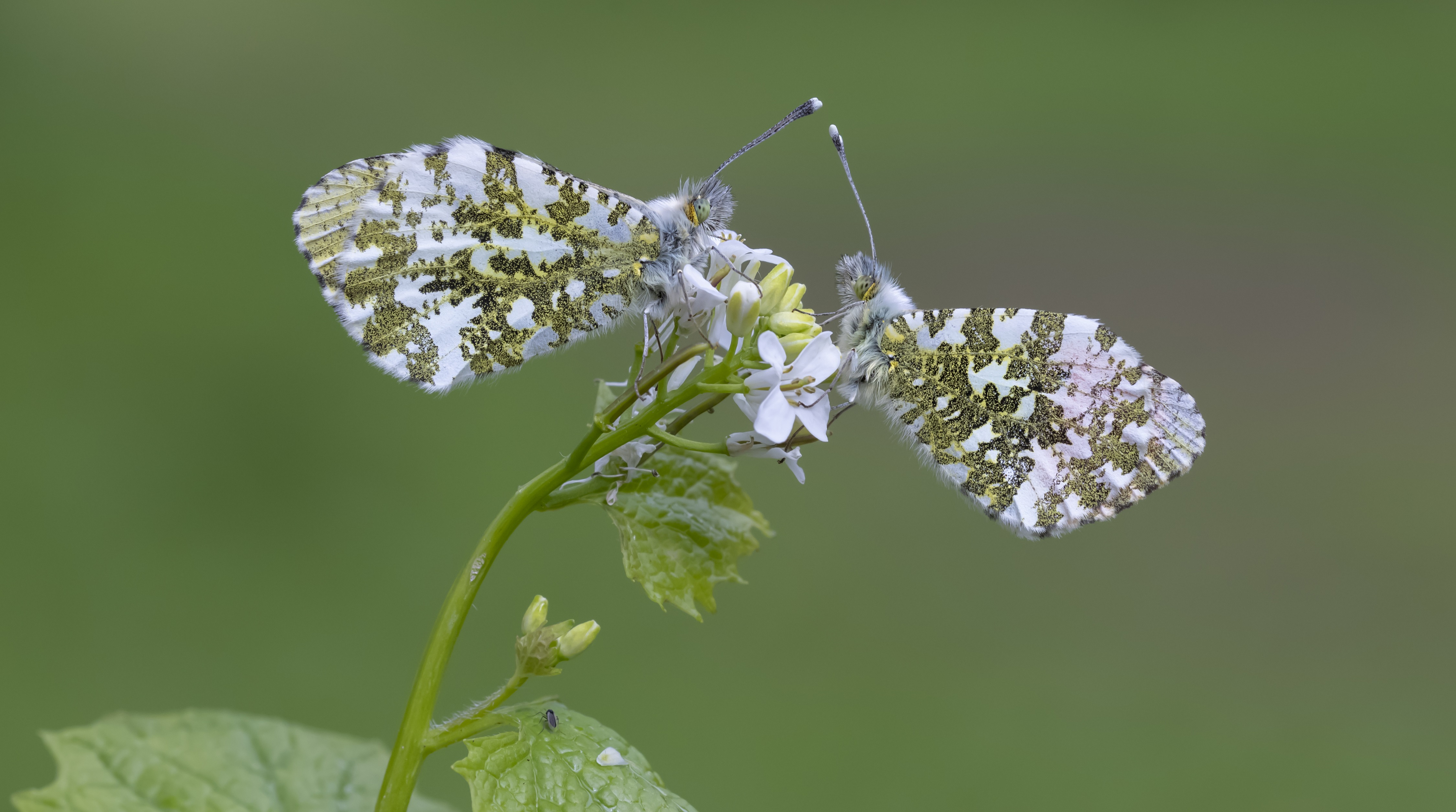
Strangely though, all of my better shots this year of Orange-tips have come from East Sussex. I have always wanted to get shots of the male and female together, and that opportunity came a couple of weeks ago on a cold breezy day. Not ideal for photographing butterflies, accept that when they are asleep they do at least keep still. With the light being so poor I did take quite a few shots to make sure I had some without wind shake and hopefully good focus. In the end I managed around 6 acceptable images that I was really pleased with. Just before the 2nd shot below, the sun almost came out, and that was enough to wake the male up enough for him to show a hint of orange.


Orange-tip pair. (female on left).


A few days later, and I was meeting Nigel in Abbotts Wood. It was only a few days earlier that we had been chatting about how unusual it was to see some types of butterflies mating, and how good it would be to see Orange-tips mating. I can only remember seeing it once, and that was in France!! Nigel too, had only seen it once, several years ago. Anyway, there I was walking to the area where we were meeting, I had already stopped and listened, and seen Nightingales, so I was feeling good about life. I then spotted 2 'white' butterflies about 50 metres ahead of me around a patch of Bluebells. They then descended together and I wondered if it was a pair of Green-veined White or Orange-tip possibly going to mate. By the time I had got to them and seen that they were indeed Orange-tips, they were already attached, sitting in a very nice position on top of a Bluebell. I now just hoped Nigel would hurry up and arrive. Moments later, my phone rang, and it was Nigel saying he was on his way. When I explained what I was looking at, he told me he had just had a mating pair near where he had parked his car!! Anyway, he was then able to see my pair as well, so he had seen 2 mating pairs in around 10 minutes!!

We both took many photos of my pair, and also from both sides. I actually prefer the ones looking into the sun as it really shows off the orange tips to the males' wings.


Mating Orange-tips on Bluebell.


The same pair looking into the light.


Another male Orange-tip hoping to get into the action.


A few more days later and I get lucky again with another male Orange-tip. This time on my local patch, and this time on Garlic Mustard, that this year has been growing in enormous quantities. It was a dullish day, but warm and muggy. The butterfly was awake, but with only a little bit of occasional sun, it wasn't too active. I had taken a few images, when it suddenly showed some of its forewing and a lovely flash of orange.


Male Orange-tip on Garlic Mustard.