Followers

Thursday, 22 August 2024

Return to The Dolomites.

 In early July I co-leaded another wonderful butterfly tour to the Dolomites with Naturetrek. This was my 3rd time on this trip, and as ever, it was a fabulous experience being in such a wonderful part of the World. Every day there were superb landscapes and some stunning wildlife to admire.

The hotel we use is also set in a stunning area, with some of the best meals around, being attached to a Michelin star restaurant that uses the same chef for the small family run hotel.


The morning view from my room!!


The Hotel.


As it was, the weather during the early part of the year in the Dolomites was just as mixed as in the UK, with wet cool conditions that had pushed the butterfly season back a little bit. We did see several species that we would have expected to have finished, but it also meant we missed a few species that we would have expected. However, during the 8 days spent out in the field we still saw many delights up in the mountains and also in some of the lower areas.

As ever, when I am leading, or co-leading a tour I take very few photos, but a few that I did take and like are below.

On the way from the airport at Venice, we stopped near the gateway to the Dolomites, climbing up what was probably only classed as a high hill. On the way up we saw many Woodland Grayling that were warming themselves up on the road. As we got higher other species started to appear, and near the summit we all got out of the vans to see what we could find. The roadsides were full of many species, with some lovely False Heath Fritillaries that were my favourites at this first site. In previous years these have been very worn, but here, along with the Southern Heath Fritillaries were very fresh. This included a female Southern Heath Fritillary that was crawling up the grasses. Possibly only just emerged, she climbed up, rejecting the advance of a male, and then opening her wings wide once she had reached the top of the grass and had transferred herself onto some Bedstraw.


A newly emerged Southern Heath Fritillary.


Female Southern Heath Fritillary.

Whilst searching around we also had a very fresh Chalkhill Blue and a few other delights as well as hearing a Corncrake, just a couple of weeks after Lisa and I had heard them on the Isle of Iona on our Mull trip.


Male Chalkhill Blue


Large Wall Brown resting on the crash barrier!!


Pearly Heath.


One of the best butterflies on the tour was the Asian Fritillary. A species that only one couple had seen on last year's tour. The late season certainly helped here though, as we spotted several on our first day in the mountains. We also saw them in other areas that they were not known from, so perhaps it was a particularly good year for them this year.


Asian Fritillary.


On the same day further down the valley we found a mating pair of False Heath Fritillaries. I was really keen to get some shots of this couple, as the female was extremely fresh. As well as getting a nice image of the under-wings I was pleased to get the female as she opened her wings to reveal that she was actually an aberrant form with extended orange markings.


Mating False Heath Fritillary (aberrant female).


Mating False Heath Fritillaries.


On another day I managed a different False Heath Fritillary open wing showing the normal pattern.


False Heath Fritillary.


The most showy butterfly on the tour had to be a stunning Apollo. Unfortunately, it didn't settle in a particularly nice position, but I was still well pleased to at last get an close up image of one of these iconic butterflies.


Apollo.


Apollo.


Apollo.


After many searches on Mull for the Slender Scotch Burnet, and failing, it was quite a surprise to find that there were several of them in the vicinity of the hotel, as well as further along the valley. Not the very rare sub-species that is found only on Mull, but still nice to see.


Slender Scotch Burnet.


Wood White.


Black-veined White.


Roosting Black-veined White.


Amanda's Blue.

In one meadow I spotted a female Six-spotted Clearwing resting on the top of some grass. A beautiful small species that is rarely seen.


Female Six-belted Clearwing.


Back in the valley, on our return to the airport, we stopped near a river. Here there were many butterflies in the lowlands. Here I saw my first ever Large Chequered Skipper and Great Sooty Satyr. Here we also had Swallowtail, Provencal Short-tailed Blue, Scotch Argus and some of the group also had a Purple Emperor.


Provencal Short-tailed Blue egg laying.


Large Chequered Skipper.


Great Sooty Satyr.


As mentioned earlier, the weather had been cool during the early part of the year, and there was much more snow on the mountain tops this year. However, the scenery was just as stunning, and perhaps even more so due to this!!


Another view of the hotel from the nearby meadow.


Hopefully I will return again next year!!


Tuesday, 20 August 2024

Feeling Autumnal.

 It is certainly feeling that summer is on the wane already, and that Autumn is very nearly with us. The local downland now is coming into flower with Devil's-bit Scabious and Autumn Lady's-tresses and many of the wild flowers are getting their seed-heads, although most of the trees are still a little way off changing colour.


Autumn Lady's-tresses.


Some of the late summer insects are also increasing in number now, with several Hornet Robberflies being seen, as they hunt smaller insects. As in previous years, grasshoppers seem to be a favourite prey item for them!!


Hornet Robberfly with grasshopper prey.


Female Wasp Spiders and their amazing webs are also now a common sight. These also enjoy a tasty grasshopper for lunch. They even add additional strength to their webs to help stop the grasshopper from jumping away. They do also, of course, take other insects as food. I did see a female Wall Brown in a web recently, and other small butterflies and flies are also taken, and even the male Wasp Spider can be a snack for the much larger female if he isn't very careful.


Female Wasp Spider with small fly.


Female Wasp Spider hanging around..


A little later this year, which seems to be a trend, the Adonis Blue butterflies are now starting their 2nd brood. I saw my first 2nd brood last week on Wednesday, just a single one seen, but now already numbers have grown at the same site to around 50. Hopefully many more to come still. On a very breezy and dull afternoon, I found several going to roost. The breeze made it very difficult for photography, but eventually a slight lull in the breeze allowed a few attempts, however, only one effort was worth keeping.


Male Adonis Blue.


Sunday, 11 August 2024

Iping Silver-studded Blues.

 Going back in time to when Lisa and I returned from our epic Scotland trip, the day following our return, Lisa was busy, so I was heading back to Seaford.

However, as I had missed seeing the Silver-studded Blues in 2023, and as I was already halfway to the site, as I was in Worthing, I decided that it would be a great opportunity to head to Iping Common, near Midhurst, to catch up with this delightful butterfly.

I would have liked to have got there at the crack of dawn, so I could try to find them at roost, but as the weather was not going to be amazingly hot, with quite a bit of cloud, I thought I would probably see them at roost some of the day anyway.

Seeing reports from across the country, it seemed that the Silver-studded Blue was actually having a reasonable year, unlike most species of butterfly.

I headed straight away to an area where I have seen the butterfly in years gone by, and it wasn't long at all before I started to see some of them flying low over the heather. I was really hoping to see a mating pair, but alas, that was not going to happen. Most of the butterflies were very flighty, despite the weather, but I was soon photographing a female butterfly that was sticking to a small area as it nectared on the heather.


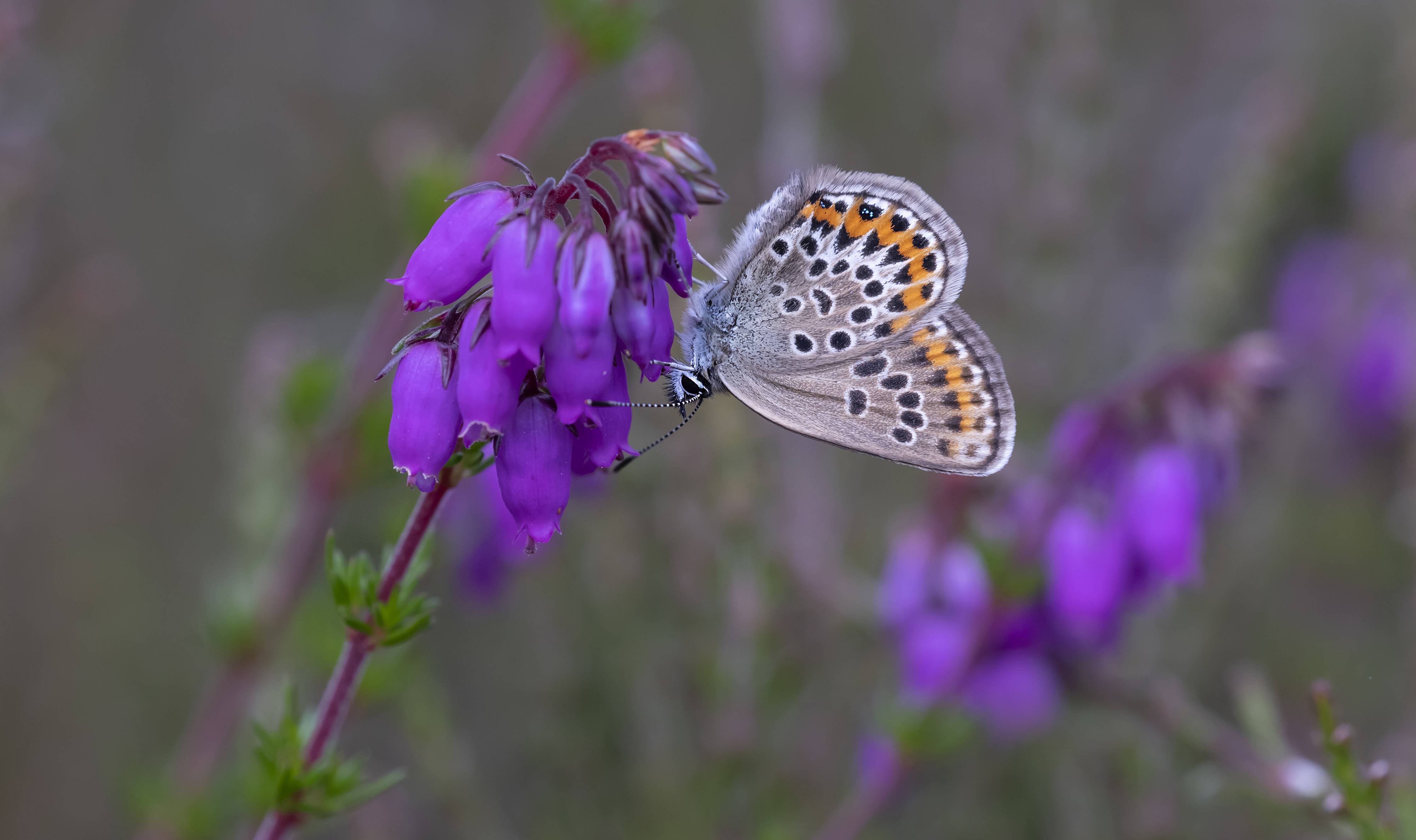
Female Silver-studded Blue.


Occasionally the butterfly would pause and open its wings to gain heat from the sun through the light cloud cover.


Female Silver-studded Blue.


I actually spent around 30 minutes with this individual, as it gave me many opportunities to photograph her. Both as she carried on nectaring and then basking open winged.


The same Female Silver-studded Blue.


Eventually, I left her in peace, and headed further along the path. As usual here, the butterflies were often in small groups, and it was after leaving the main path, that I found a male that allowed a closer inspection.


Male Silver-studded Blue.


After a longer walk around the common, I was back to where I had started with the female. By now she had moved on to another area, but I was then treated to a very fresh male butterfly. He was nectaring on the heather, giving me the odd opportunity. Not quite as confiding as the female, but still very nice.


Male Silver-studded Blue.


By now heavier clouds were building, and eventually the male went to roost in the heather. On looking up to the sky, I could see that lighter clouds were coming soon, and as they arrived, the male opened his wings quite wide to show off its beautiful blue top wings.


Male Silver-studded Blue.


It was fabulous being able to catch up with these butterflies after not seeing them for a couple of years. I was very lucky that the weather helped, by not being too hot and sunny, and it was also good to find some in immaculate condition.

A couple of weeks later, Lisa also had the opportunity to seeing some Silver-studded Blues, at the other main Sussex site on Ashdown Forest. By now these were not quite as fresh, but still not bad. The weather however, was not at all good, with cold strong breezes and even some light rain. I ended up not taking any photos, not actually that unusual, but Lisa did get some nice images.


Saturday, 3 August 2024

Blue Eyes.

 My last blog post about Dragonflies gave me a little inspiration, as I have probably been neglecting this group of insects recently. 

Last weekend I gained further inspiration, when Lisa and I were on Pevensey Levels, and I found a rare Lesser Emperor, as well as seeing a Norfolk Hawker.

3 years ago I found a breeding area for the gorgeous Southern Migrant Hawker, also known as the Blue-eyed Hawker, within walking distance from home, and with this recent extra interest I decided to go and have a look at the site to check if the dragonfly was still using the area. More of that later!!

It was back in 2017, when the Southern Migrant Hawker came on my radar. The only really reliable site for the dragonfly back then was in Essex at Canvey Island. I had never been to Canvey Island, and I had also never 'twitched' a dragonfly before, but when Matt said he was going to Canvey to see the dragonfly, and invited me along, well, it was not an opportunity to miss. We arrived so early, we had to wait a while to see the insect, as they were all still hiding at roost, but eventually some started to fly, and what a stunning dragonfly the adult male is!!


Male Southern Migrant Hawker. Canvey Island. 14/7/2017.


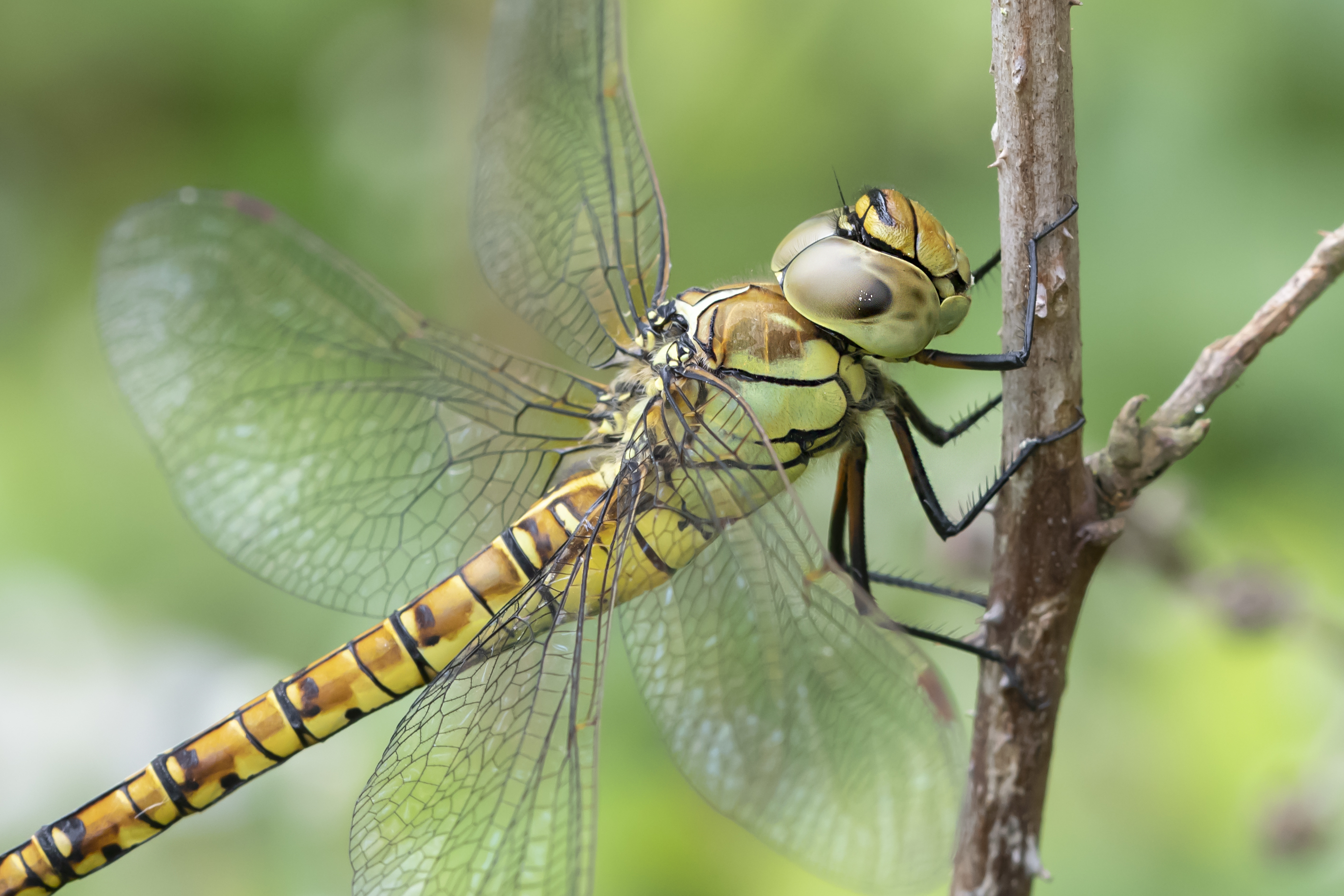
It was 3 years later that my next sighting of the species happened, and that was amazingly in my garden!! I was in the back garden, when I spotted quite a small dragonfly fly across the garden and land on the mass of Ivy that covers the fence. I knew it was different, and I had no idea at that moment what species it was. I ran upstairs to grab the camera and got back in the garden, but I stupidly hadn't made a mental note where the dragonfly was actually sitting. I panned the area and eventually spotted it. After taking a few images, I was then able to check the dragonfly books. I was amazed that it was a teneral (immature) Southern Migrant Hawker. Possibly the first sighting for Seaford? And it had chosen my garden!!


Teneral Southern Migrant Hawker. Seaford 6/7/2020.


This species when it emerges from it's larval underwater life into a dragonfly, it will leave the area where it emerged until it is fully mature. This means that teneral dragonflies can literally turn up anywhere within a few miles of the breeding area. I was so lucky that it chose my garden to rest. Even more amazingly perhaps was just last year, 2023, I had another one hunting for insects over the garden. My garden is obviously in the area that they mature in.

My next encounter came in 2021, when James and I were searching for Scarlet Tiger moths in Friston Forest. We were walking along a ride that held a few of the moths when we spotted a teneral Southern Migrant Hawker. Fortunately, it flew only a very short distance, and we were both able to get some nice photos of it. We did see several more of them over the next couple of weeks and it was clear then that the species was becoming more numerous in the Seaford area.


Teneral Southern Migrant Hawker. Friston Forest. 11/07/2021.

Only 4 days after seeing this one I then found another in a private wood near Ringmer that I survey for butterflies.

Just over a month later was the day that I found the breeding area for the species, close to home in the Cuckmere valley. This was a day that I will never forget, as it was a very sad day for me, as it would have been Penny's birthday, the first one since I had lost her in April. 

The local Lace Border had already tried to cheer me up when an extremely fresh individual had sat perfectly for me giving me what is still by far, my best photo of this stunning little moth. (maybe the moth knew that I needed to be cheered up, or maybe Penny's spirit placed it there for me)!!

 So to then find the breeding area of a rare dragonfly just 40 minutes later, I was in a much brighter mood when I got back home!! I also managed to get a few half decent flight shots. Of course by now the dragonflies were fully mature with the bright blue eyes that gives them their alternative name.


Male Southern Migrant Hawker. River Cuckmere 16/8/2021.


A week later I visited the site again and found a male at rest. Something that the mature adults rarely seem to do!!


Male Southern Migrant Hawker at rest River Cuckmere 23/8/2021.


What is probably my best image of a teneral then came in June 2023 along Cradle Valley when I was actually looking for Norfolk Hawkers, which had also by then reached this part of the country. I saw the dragonfly in flight and realised what it was before it landed this time. I was lucky that it landed head height, as after taking the photos it next landed much higher in the bush and well out of reach.


Teneral Southern Migrant Hawker. Cradle Valley 18/6/2023.


So, we now come to this past week, when I have had 3 sessions with the dragonflies at the local breeding area. Up to 10 males have been seen as well as possibly 3 females. Twice in tandem with males. It certainly is a challenge photographing them in flight as they are constantly moving about at high speed, only occasionally hovering in one spot for a second or two. Unless you are in exactly the right spot you have no chance. But, one did hover in the right area on each occasion, giving me the fighting chance I needed. There is still plenty of room for improvement, so fingers crossed for next time.


Male Southern Migrant Hawker in flight. River Cuckmere. 30/7/2024-1/8/2024.


After the final photos were taken, the weather clouded up and I started looking for them at roost as they had stopped flying. Eventually I found one sleeping on a Blackthorn bush.


Male Southern Migrant Hawker. River Cuckmere. 1/8/2024.


I have really enjoyed the days spent with this stunning dragonfly, and the challenge of photographing them. They have increased in number so quickly in the Seaford area, and it's well worth looking out for them in both their immature stage, right through to seeing them with those incredible 'Blue eyes'.